HBR’s Who’s Got The Monkey
In 1974, William Oncken Jr. and Donald L. Wass published a short article in the Harvard Business Review called “Management Time: Who’s Got the Monkey?” It went on to become one of the two best-selling HBR reprints of all time. I often mention this paper to my more junior colleagues but they are discouraged by the seven-page PDF, so here is the shorter version.
The paper is still very relevant today because the problem it describes has not gone away. If anything, in a world of Slack messages, constant stand-ups, and always-on collaboration, the monkey has more places to jump than ever before.
The Central Metaphor: The Monkey
A “monkey” is the next action on a problem. It is not the problem itself - it is who has to make the next move. The entire article revolves around one observation: in most manager-subordinate interactions, the next move quietly shifts from the subordinate to the manager, without either party fully noticing.
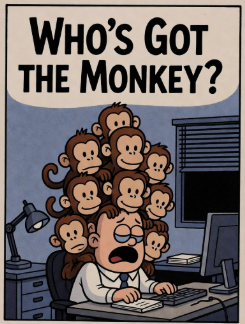
Sad boss
What this looks like in practice: A teammate catches you after standup and says, “Hey, we have a problem with the deployment pipeline - I’m not sure what to do.” You reply, “Let me think about it and get back to you.” Congratulations: the monkey just jumped from their back to yours. They walk away free. You walk away with another task on your list. And later, they will be the one checking in on you.
The Three Types of Time
Oncken and Wass break a manager’s time into three buckets:
- Boss-imposed time is the work your own manager requires of you.
- System-imposed time covers cross-functional obligations - peer requests, process compliance, organisational coordination.
- Self-imposed time is everything else: things you initiate or agree to do. This is the only bucket you actually control.
The key insight: your leverage as a manager lives in discretionary time. Every monkey you accept from a report shrinks that pool. Accept enough of them, and you have zero time left for the strategic work that only you can do.
How Monkeys Jump: Four Patterns to Recognise
The paper walks through four scenarios that are instantly recognisable in any modern workplace:
- The hallway handoff. Someone raises a problem in passing. You say, “Let me think about it.” The monkey is now yours.
- The memo trap. You ask someone to write up their thinking. They do. Now the document is in your inbox, and the next move is yours.
- The open-ended offer. You tell someone, “Just let me know how I can help.” They cannot move until you review their work, but your review queue is perpetually full.
- The draft-first mistake. A new initiative needs objectives. You say, “I will draft something for us to discuss.” You now own the next move on their project.
In every case, the transfer is subtle. Both parties walk away believing they are being collaborative. But the operational reality is that the subordinate is now idle and the manager is now busier.
The Fix: Five Degrees of Initiative
Oncken and Wass propose a simple ladder of initiative that any team member can operate on:
- Wait until told what to do.
- Ask what to do.
- Recommend an action and execute once approved.
- Act first and inform immediately after.
- Act independently and report routinely.
The paper’s prescription is blunt: levels 1 and 2 should be off-limits for any professional. The goal is to operate at level 3 or above - come with a recommendation, not just a problem.
The Five Rules for “Care and Feeding of Monkeys”
Rule 1 - Feed them or shoot them. Every open item either gets active attention or gets killed.
Rule 2 - Cap the population. You can only sustain a finite number of active items.
Rule 3 - Feed by appointment only. Do not chase down status updates ad hoc.
Rule 4 - Feed face-to-face or by phone, never by email. Asynchronous communication hands the next move back to the manager.
Rule 5 - Every monkey needs a next feeding time and an agreed level of initiative. No ambiguity.
The Covey Update: Empowerment Is Harder Than It Sounds
When HBR republished the article in 1999, Stephen Covey added a commentary acknowledging that the original advice - “give the monkey back” - was necessary but not sufficient. You cannot simply refuse to take on a subordinate’s problem if they lack the skill or confidence to solve it themselves. Effective delegation requires investing in people, building trust, and creating a culture where initiative is rewarded rather than punished.