This series is based on the Ackoff Tapes - video lectures by Russell L. Ackoff, professor at the Wharton School of the University of Pennsylvania, consultant to over 250 corporations and 50 government agencies, and one of the twentieth century’s most consequential thinkers. The tapes were recorded for the Naval Education and Training Organization and cover systems thinking, management philosophy, organisational design, and education. Each post follows the arc of a different tape, but the ideas build on one another. Read them in order.
We are in the middle of a transition from one historical age (the Machine Age) to another (the Systems Age), and most organizations - including the Navy - are still managing using ideas inherited from the old one. The purpose of these days is to understand what’s changing and why, and to adopt a fundamentally different mode of thinking and planning.
DISCLAIMER: I watched the Ackoff Tapes back in 2023 and found them so impactful that I wanted them in readable/searchable/sharable form. The below blog post(s) are based on Whisper transcriptions of the recordings and have been compiled into a series of posts by Claude Cowork, unedited.
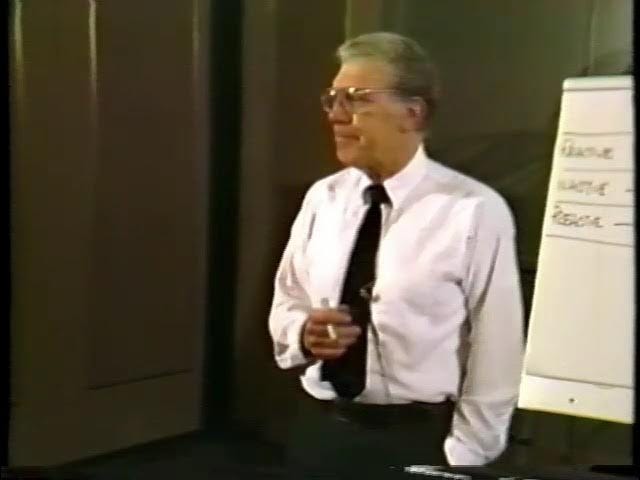
Russell L. Ackoff
Overview
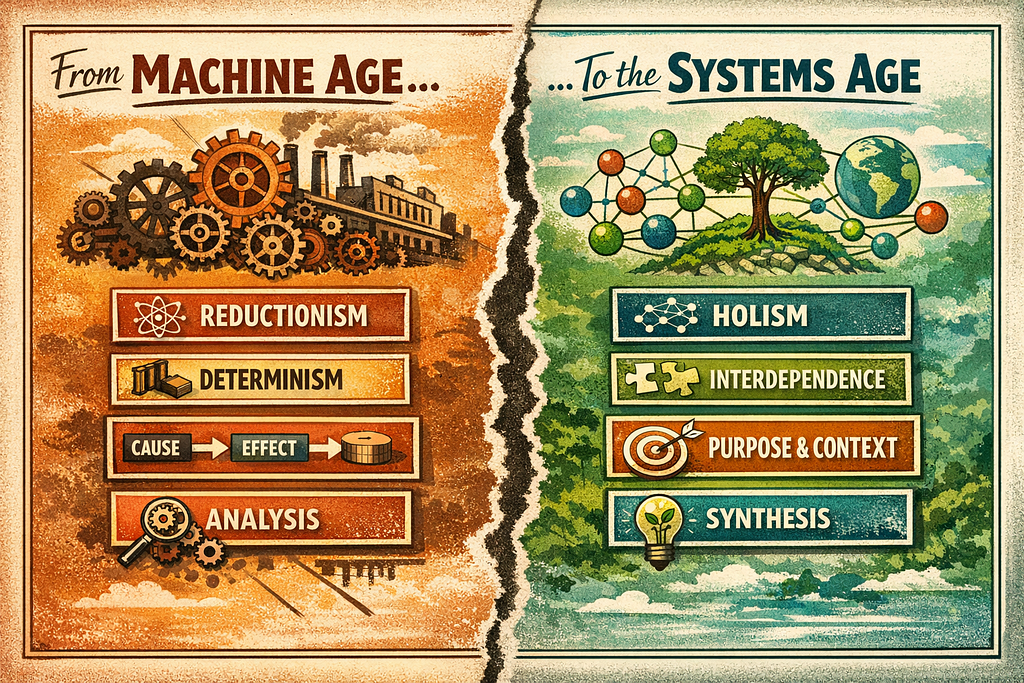
Tapes 1 & 2 - The philosophical foundation. Ackoff opens with an epistemological distinction that sets the tone for everything: information, knowledge, and understanding are not the same thing, and almost all education operates at the wrong level. He then launches his historical thesis: the Machine Age worldview - rooted in the Renaissance, shaped by Descartes and Newton - gave us analysis, reductionism, and the idea that you understand something by taking it apart. That worldview is now breaking down.
Tape 3 - The technological shift. The Systems Age has its own technological expression: not mechanization (replacing human muscle) but automation (replacing human mind). Instrumentation, communication, and the computer - taken together - created a technology of the mind. Ackoff then pivots to the concept of development (as distinct from growth), illustrated with a vivid personal story from WWII, building a rest camp in the Philippines with 250 native workers and no materials - a parable about resourcefulness over resources.
Tape 4 - How organizations and work must change. He traces the evolution of how companies have tried to manage human motivation: job rotation -> job enrichment -> semi-autonomous work groups (the Volvo Kalmar factory being the landmark example). The lesson: each solution works for a while, then stops - so you need a portfolio of approaches and a systems view, not a single fix. Education and training emerge as inseparable from good work design.
Tape 5 - The “Reactive” organization. Ackoff introduces his three-way typology of organizational orientations. “Reactive” managers are past-oriented, nostalgic, problem-focused, and plan by cataloguing deficiencies and submitting project budgets upward. He dissects the budget ritual with sharp irony - the standard multiplier, the boss correcting spelling, the safety factor added at each level - and shows why this produces organizational paralysis.
Tape 6 - The “Preactive” organization. The dominant American management style of the postwar decades: technology-worshipping, forecast-obsessed, top-down, MBO-driven. Change is opportunity; youth is prized; the sports team is the metaphor. Ackoff shows why this fails too: forecasting accuracy degrades precisely as the environment becomes more turbulent - which is exactly when you need it most.
Tape 7 - The “Interactive” organization and idealized redesign. The synthesis and the heart of the seminar. Ackoff introduces “interactive planning” - not reactive (fix what’s broken) or preactive (predict and prepare) but designing the future you want and working backwards. The key tool is idealized redesign: imagine the system was destroyed last night and you are free to replace it with anything. The touchstone telephone story (his accidental attendance at a Bell Labs meeting in 1951, which led to push-button dialing and eventually the entire digital telephony revolution) is his central illustration of how this method works in practice.
Tape 8 - Education, creativity, and closing. He applies the same systems thinking to education - a Mexican university he helped redesign from scratch, the cooperative program, the trimester calendar, building for two-thirds occupancy. He returns to the epistemological theme from Tape 1: schools teach kids to answer questions (and give the answer the examiner expects), not to formulate and manage “messes.” The nine-dot problem with his daughter is the emblem of how institutions suppress creativity. He closes with a joke from his seven-year-old son.
Tape 1 & 2 - The Age We’re Leaving Behind: From the Machine Age to the Systems Age
(Based on Ackoff Tapes 1 & 2)
There is a question Ackoff says his students keep asking him. It is, he admits, the simplest question in the world to ask and perhaps the most difficult to answer. The question is this: what in the world is happening in the world?
Not what the latest quarterly figures say. Not what the news cycle is currently amplifying. At a very general level - philosophically, historically, culturally - what is actually going on?
Ackoff’s answer, delivered with the unhurried confidence of someone who has spent decades thinking about it, is both clarifying and unsettling. We are, he says, in the early stages of a change of age. Not a change within an age - a change of age. A transformation of the kind that happens once every several hundred years, the kind that reshuffles the foundations of how human beings understand reality itself.
To appreciate what that means, you need to understand what a historical age actually is.
The World Through Which We See the World
Every historical era, Ackoff explains, is defined not by its technology or its politics but by its dominant worldview - what the Germans call a Weltanschauung. A shared, largely unarticulated set of assumptions about the nature of reality. We all have one. The trouble is that we absorb it by osmosis as we grow up, which means it becomes so deeply ingrained that we stop being able to see it. It is not the picture we look at. It is the lens we look through.
When a worldview begins to crack - when the dilemmas it generates can no longer be resolved within its own terms - a historical age starts to end. The last time this happened to Western civilisation on a comparable scale was the Renaissance: the transformation from the Middle Ages to what Ackoff calls the Machine Age.
The medieval worldview makes sense when you understand the conditions that produced it. Expected lifespan was 27 years. Forty percent of children died in childhood. The average person never traveled more than four miles from their place of birth. Over ninety-five percent of people lived in abject poverty. In that world, the most urgent question was not how to improve conditions here. It was what to make of the fact that this life is brutal and brief. The church’s answer - that earthly life is merely preparation for an infinite afterlife, and therefore not worth worrying too much about - was not cynicism. It was a rational response to the available evidence.
What ended that worldview was exposure. The Crusades sent large numbers of European men across the face of a continent they had never seen, into contact with cultures they had never imagined. Curiosity - which had actually been declared a sin by the medieval church - became a virtue. The New Humanism emerged. Ancient Greek learning, transmitted back to Europe through Arab scholarship, was rediscovered. Aristotle and Plato returned. And with them came a new belief, both liberating and totalising: that the universe was capable of being completely understood.
That belief - held with sincere conviction for nearly four hundred years - became the first pillar of the Machine Age worldview.
The Machine Age: A Philosophy Built on Two Pillars
The second pillar was a method: analysis. Watch a child given an unfamiliar object - a clock, a toy, something they have never seen before. What do they do? They take it apart. They try to understand the parts separately. Then they try to piece the understanding of the parts back into an understanding of the whole. That intuitive process, systematised and elevated into scientific doctrine, is analysis. Break it down, understand the pieces, aggregate upward.
From these two foundations - complete understandability and analysis - a worldview crystallised into four interlocking doctrines.
The first was reductionism: the belief that everything in the universe, if taken apart far enough, reduces to simple, indivisible elements. Atomic theory in physics. The cell in biology. The phoneme in linguistics. Science became, for four centuries, a crusade in search of the fundamental element - the holy grail from which understanding of everything else would flow.
The second doctrine was determinism - more specifically, the belief that all relationships in the universe reduce to a single type: cause and effect. A cause is something necessary and sufficient for its effect. This was taken to be the complete grammar of reality.
From those two, two further doctrines followed almost automatically. The third was that explanation required no reference to the environment. If a cause is sufficient for its effect, nothing outside the relationship is needed to explain it. Hence the Law of Freely Falling Bodies - notable for that word freely, meaning in a vacuum, in the absence of an environment. All fundamental laws of physics describe behaviour in conditions no environment actually provides. That is not a bug; it is the design.
The fourth doctrine was the inevitability of a First Cause - an uncaused cause, something that set the chain in motion without itself being caused. Call it God, or call it the initial conditions of the universe. Either way, the logic required it.
This worldview gave rise to extraordinary things. The scientific revolution. The industrial revolution. Germ theory. Engineering. Flight. Modern medicine. For four hundred years, the Machine Age worldview delivered compounding returns on its investment.
But then, around the turn of the twentieth century, the cracks began to appear.
The Dilemmas the Machine Age Could Not Resolve
The deterministic worldview, if taken seriously, eliminates free will. If every event is the necessary and sufficient consequence of its cause, then human choice is an illusion - your decision right now was determined at the Big Bang. Philosophers and theologians wrestled with this for centuries without resolution, because the dilemma cannot be resolved within the Machine Age framework. It is a dilemma, not a problem.
Then came Heisenberg’s uncertainty principle, which demonstrated that complete knowledge of a physical system is not merely difficult but logically impossible. The act of observation changes what is observed. The foundational belief of the Machine Age - complete understandability - was shown to be false on its own terms, by science itself.
And then came the insight that would eventually crystallise into systems theory: some properties of wholes cannot be found in any of their parts. When you take a system apart to understand it through analysis, you destroy the very thing you are trying to understand. The life of a cell is not present in the molecules that compose it. The meaning of a word is not present in its letters. The personality of a person is not present in their organs. Analysis, the great method of the Machine Age, turns out to be capable of explaining everything except the most interesting things.
The Systems Age and the New Conceptual Architecture
What replaces these doctrines is not their negation but their expansion.
Reductionism gives way to expansionism - the recognition that things can be understood not only by breaking them down but by seeing them as parts of larger containing systems. Understanding something now requires both analysis and synthesis: you must look inward at the parts and outward at the whole in which it is embedded.
Determinism gives way to a richer conception of causality. The philosopher Edgar Arthur Singer, Ackoff’s teacher, proposed a distinction that would reshape everything downstream. An acorn does not cause an oak tree in the Machine Age sense - if it did, every acorn would become an oak, regardless of soil, water, or sunlight. The acorn is a producer of the oak tree: necessary but not sufficient, requiring a cooperating environment. This might seem like wordplay, but its implications are profound. It breaks the closed loop of determinism. It makes purposefulness, and therefore genuine choice, conceptually possible again.
From this flows a new taxonomy of systems:
- Machines have no purpose of their own. Their parts may have functions, but the system exists only to serve external purposes.
- Organisms have purposes of their own, but their parts do not.
- Organisations - the category most relevant to management - have purposes of their own, and so do their parts, and they are themselves embedded in larger purposeful systems.
This is not just a philosophical distinction. It is a diagnosis. And it explains why the management of organisations in the Machine Age went so systematically wrong - and why the problems it generated are the problems that now define our moment.
Why This Matters Right Now
The crises of the modern era - what Ackoff calls the humanisation problem - are all, at their root, consequences of purposeful parts demanding that their larger systems serve their purposes. The environmental movement is purposeful nature (or nature’s advocates) demanding that organisations serve it. The consumer movement is purposeful customers demanding that firms serve them. Third World nationalism, the women’s movement, the civil rights movement - all are purposeful parts of larger systems asserting that they will not be treated as mere components.
You cannot manage organisations in this world using Machine Age thinking. You cannot break the challenges into isolated problems, optimise each part separately, and expect the whole to function. The parts are alive. They have purposes. They will resist. And they should.
The next question - the question the rest of this series takes up - is: what does it look like to manage, plan, and lead in the Systems Age? What does it look like to design organisations that genuinely serve the purposes of society, of the organisation itself, and of every purposeful person within it?
We are still, mostly, trying to answer that question with Machine Age tools. Ackoff spent his career proposing the alternative.
The next post follows Tape 3, where he turns from philosophy to practice: what does the Systems Age demand of how we organise work, distribute wealth, and relate to the human beings inside our institutions?
Tape 3 - Organisations as Living Systems: Automation, Development, and the Stakeholder Firm
(Based on Ackoff Tape 3)
If the first post established the philosophical stakes - the transition from Machine Age to Systems Age thinking - this one is where the ideas meet the ground. Ackoff turns from worldviews to workplaces, and what he finds there is an institution - the corporation - that is almost perfectly designed for the wrong era.
But he also finds, in the chaos and dissatisfaction of the late twentieth century, the raw materials for something better.
The Technological Underpinning: Why Automation Changes Everything
Before getting to organisations, Ackoff pauses to name the technological force that makes the transition from Machine Age to Systems Age not merely philosophical but historically inevitable. That force is automation.
To understand automation, you have to understand what preceded it. Mechanisation - the first industrial revolution - applied energy to matter. It replaced human muscle. Steam engines, looms, locomotives: all of these extended the physical capacity of the body. Measurement and instrumentation came next, creating tools that could observe and record in ways human senses could not. Then came communication technologies that could transmit information across distance.
But automation is something qualitatively different. When you combine instrumentation (sensing), computation (manipulating symbols), and communication (transmitting information), you get a system that can replace not muscle but mind. Automation does not merely extend human capacity - it substitutes for human cognitive work. The bookkeeper, the typesetter, the draughtsman, the navigator: all find that their function can now be performed by a machine.
This is not an argument about whether automation is good or bad. It is a statement about what it does structurally to work and to organisations. If machines can do an expanding range of cognitive work, then the nature of human value in organisations must change - or large numbers of people will simply be unnecessary.
Ackoff identifies unemployment as the central social crisis generated by automation, and he frames it in a way that most economic commentators miss. A corporation does two things for society simultaneously: it produces wealth and it distributes wealth. Employment is the only mechanism that does both at once. When you pay someone to do work, you create value (production) and you put money in their pocket (distribution). Welfare, by contrast, only distributes - and it does so in a way that tends to corrode the dignity and development of the recipient.
The political consequence is predictable and visible: governments find themselves under pressure to nationalise industries or expand public employment not because state ownership is ideologically preferred but because the alternative is a growing proportion of citizens with no mechanism through which to participate in economic life. This is not primarily a political problem. It is a systems design problem.
Development vs. Growth: The Most Important Distinction You’re Not Making
Here Ackoff introduces a distinction that deserves far wider currency than it has received.
We tend to talk about development and growth as though they are the same thing, or at least as though more growth automatically means more development. Ackoff insists they are fundamentally different concepts, and confusing them has enormous consequences.
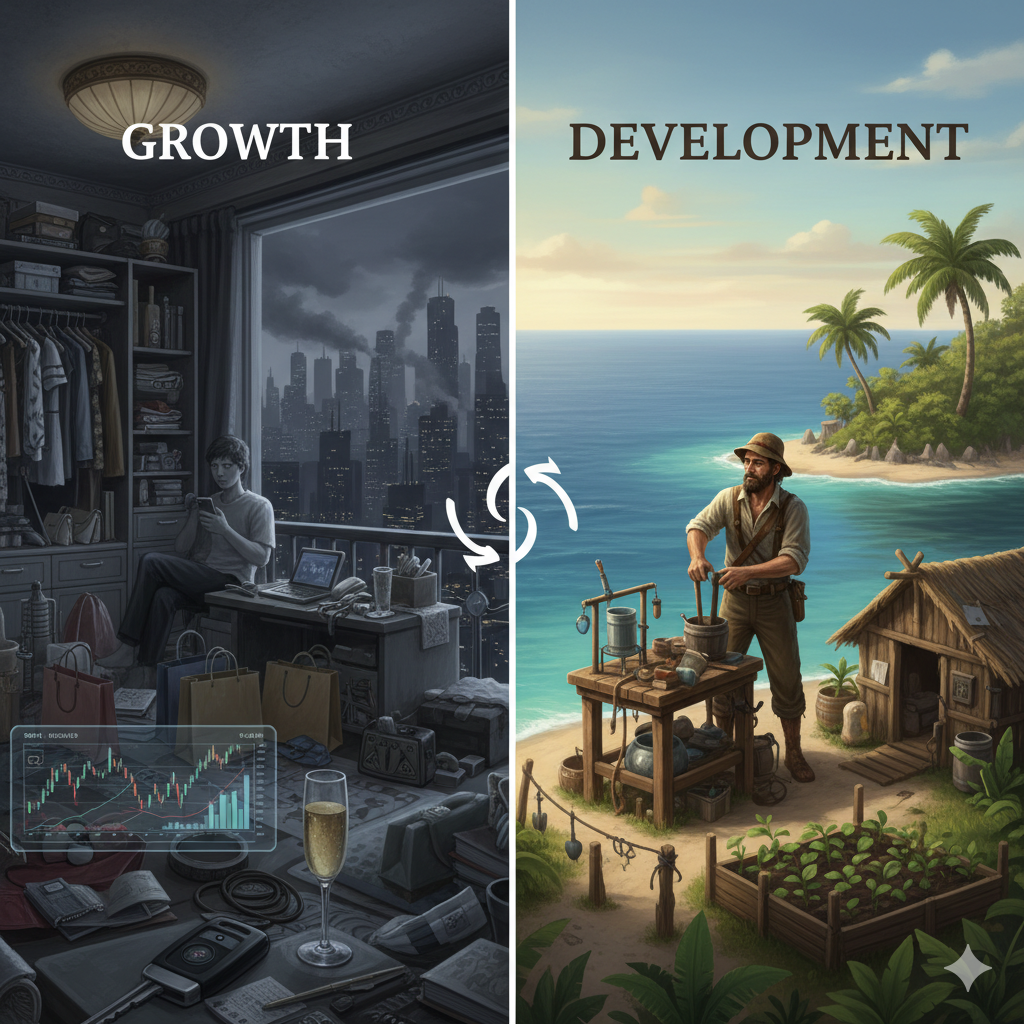
Growth means an increase in size or amount. A tumour grows. A landfill grows. Growth is morally and practically neutral; whether it is desirable depends entirely on what is growing and why.
Development, by contrast, is an increase in capacity and desire to satisfy one’s own needs and the needs of others using whatever resources are available. It is about what you can do, not what you have. It is about the quality and effectiveness of your relationship to your circumstances.
To illustrate the difference, Ackoff offers the figure of Robinson Crusoe - a man with almost no resources who nonetheless exhibits extraordinary development. Faced with an unprecedented situation, without tools, without infrastructure, without supply chains, he improvises solutions, learns rapidly, builds capabilities, and survives. Now contrast him with a billionaire who cannot manage their own emotional life, cannot sustain meaningful relationships, and cannot function without an elaborate support system. The billionaire has resources; Crusoe has development. They are not the same thing.
The implications are radical. No government can develop a population. A government can provide resources, remove obstacles, and create enabling conditions. But development is inherently self-development. It happens when people encounter real challenges and engage with them using their own intelligence and agency. It is precisely what organisations - and educational institutions, as we will see in later posts - tend to destroy when they treat people as components to be managed rather than purposeful beings to be supported.
The Stakeholder Map: Seeing the Organisation from Outside In
Ackoff now offers a reframing of the corporation that was, at the time he was delivering these lectures, genuinely radical, and that has since become mainstream in name if not always in practice. He asks us to think about the organisation not from the inside out - not from the perspective of what the firm is trying to achieve - but from the outside in: who are all the parties who have a stake in what this organisation does, and what does the relationship look like from each of their perspectives?
He identifies six stakeholder groups:
Employees bring their time and labour in; they expect money, purpose, and meaningful work out. Suppliers bring goods and services in; they expect payment out. Customers bring money in; they expect value-added goods or services out. Creditors bring money now; they expect more money later. Investors put money in; they expect returns over time. Government provides infrastructure, the rule of law, and a functional society; it expects taxes and compliance in return.
What this map reveals is that the corporation is not a thing - it is a web of relationships, each with its own logic, its own obligations, and its own legitimate claims. The Machine Age firm optimised for one stakeholder (shareholders, or sometimes management) and treated the rest as constraints to be managed. The Systems Age firm recognises that it must genuinely serve the purposes of all its stakeholders, not as a PR exercise but as a condition of its continued existence and social legitimacy.
From Cog to Colleague: The Evolution of How We Treat Workers
One of the most practically valuable sections of this tape is Ackoff’s account of the successive waves of thinking about how workers should be treated within organisations. He traces an evolution - tentative, uneven, often reversed - from the purely mechanical view to something approaching genuine humanity.
The mechanical view saw the worker as a replaceable part. The worker’s job was specified precisely, the motions standardised, the variability eliminated. Frederick Taylor’s scientific management is the archetype. It worked - up to a point - when the work was genuinely repetitive and when workers had no alternative. It generated efficiency in a narrow, measurable sense and alienation in every other sense.
The first response was work structuring - the recognition that giving workers some control over their immediate environment improved morale and reduced absenteeism. This was an improvement, but Ackoff is honest that its effects were temporary. Boredom returned.
Job rotation - moving workers between tasks - addressed boredom somewhat, but again the relief was short-lived. The work itself remained unchallenging; you were just doing different unchallenging things.
Job enrichment gave workers more complex and meaningful tasks - assembling a complete product rather than performing a single operation, for example. The Motorola pager plant is Ackoff’s example: when workers were given responsibility for assembling complete devices rather than working on assembly lines, productivity increased by thirty to sixty percent. This is not a marginal improvement. It is transformative.
But Ackoff pushes further, to the most radical and most effective intervention: semi-autonomous work groups. At Volvo’s Kalmar plant, there were no assembly lines. Groups of workers organised their own work, made their own decisions about scheduling and task allocation, and took collective responsibility for a complete segment of the production process. The result was a thirty-three percent improvement in output per person compared with conventional plants.
The lesson is not that specific techniques work. The lesson is that the direction of travel matters. Every step that moves toward treating workers as purposeful beings with their own intelligence and judgment - rather than as components to be optimised - generates real and substantial gains. Not because it makes workers happy (though it often does), but because it unlocks capacities that the mechanical model systematically suppresses.
The Circular Organisation: Democracy at Work
Ackoff’s most ambitious organisational proposal is what he calls the circular or democratic organisation - a structural innovation that builds genuine participation into the architecture of governance itself.
The mechanism is simple. Every manager in the organisation has a board, consisting of themselves, their immediate superior, and all of their direct reports. Every manager sits on at least two boards - the one they chair and the one their superior chairs. The boards perform several functions: policy-making within their domain, planning, coordination across parallel units, and integration between levels.
The fifth function - the most consistently resisted - is evaluation. The board evaluates the performance of its manager. In other words, no one can hold a position of authority without the ongoing consent of those they lead.
This is not a utopian proposal. It is a functional mechanism for something organisations desperately need but rarely achieve: accountability that flows not just downward and upward but in all directions. It means that authority must be earned continuously through the quality of leadership, not merely held by virtue of title.
Real examples exist. Ackoff describes a packaging company that implemented a ten-board system and Mexico’s Ministry of Public Works, where a similar structure transformed what had been a deeply dysfunctional bureaucracy. The common thread was that people at every level began to take genuine responsibility for the quality of the whole - because the structure gave them genuine power to affect it.
What This Adds Up To
By the end of Tape 3, a portrait of the Systems Age organisation is beginning to emerge. It is an organisation that:
- Recognises automation as an irreversible structural force and designs work around human development rather than human substitution
- Thinks of growth and development as different objectives and prioritises the latter
- Maps its obligations to all stakeholders, not just shareholders
- Designs work so that the people doing it are genuinely engaged, developing, and contributing their full intelligence
- Structures governance so that authority requires and depends on ongoing consent
None of this is easy. Ackoff does not pretend it is. But each component can be shown, with concrete examples, to produce better results than the Machine Age alternative - not just for workers but for the organisations themselves.
The next post follows Tape 4, where Ackoff turns to the question of planning - or rather, to why most of what organisations call planning is not really planning at all, and what a genuine alternative would look like.
Tape 4 - Planning as Design: Messes, Dilemmas, and the Radical Act of Imagining What You Actually Want
(Based on Ackoff Tape 4)
Most organisational planning, Ackoff suggests with barely concealed impatience, is an elaborate ritual that produces impressive-looking documents that nobody uses. This is not a minor operational failing. It is a symptom of a fundamental conceptual error about what planning is for.
To understand why planning goes wrong so systematically, you have to start with how organisations think about the problems they face.
Problems, Messes, and the Difference That Changes Everything
In ordinary language, we tend to use the word “problem” loosely, as a synonym for “difficulty” or “challenge.” Ackoff wants to be more precise, because the distinctions he draws carry real practical consequences.
A problem, properly speaking, is a solvable difficulty with a clear formulation and a definable solution. You can state what is unsatisfactory, you can imagine what satisfactory would look like, and you can find a path from here to there within your existing conceptual framework.
A dilemma is different in kind. It is a difficulty that cannot be resolved within the existing framework. The free will problem for the Machine Age worldview is a dilemma, not a problem: no solution is possible without questioning the foundational assumptions. You cannot solve a dilemma; you can only dissolve it, by changing the framework within which it appears.
But the most important concept is the mess - and this is where Ackoff’s thinking becomes most directly relevant to anyone trying to lead an organisation. A mess is a system of interacting problems. It is what organisations and institutions actually face. Every real challenge - declining market share, employee disengagement, regulatory pressure, technological disruption - is entangled with every other challenge. You cannot address one in isolation without changing the conditions affecting the others.
The catastrophic mistake that organisations make is to extract individual problems from the mess, hand them to specialist teams or departments, solve them optimally in isolation, and then expect the organisation to perform better. It does not work. It cannot work. Optimal solutions to individual problems, when those problems are part of a system, will not add up to an optimal solution for the system. They may not even add up to an adequate one.
The car park that is optimised separately from the building it serves, the supply chain optimised separately from the sales function, the training programme designed without reference to the work it is meant to support - these are all examples of the same error. Ackoff’s term for it is suboptimisation, and it is the dominant mode of organisational problem-solving in the Machine Age.
What Planning Usually Is - and Why It Fails
Most corporate planning follows a predictable logic. It begins with an analysis of the current situation, identifies deficiencies, sets targets for improvement, and builds a plan to close the gap. This sounds reasonable. The problem is that it begins with the present - with what is wrong - and tries to project outward from there.
Ackoff calls this reactive planning when it is oriented toward the past, and preactive planning when it is oriented toward a predicted future. Both share the same fundamental flaw: they take existing constraints as given and build within them.
The reactive planner says: here are the things that are broken; let us fix them. The preactive planner says: here is our forecast of where the market is going; let us position ourselves to capture it. Both treat the future as something to be extrapolated from or braced against, rather than something to be designed.
There is also a practical problem that Ackoff identifies with characteristic directness. In one memorable anecdote, a CEO confesses that his organisation’s elaborate annual planning process produces a thick document that is never actually consulted. When asked why they continue to do it, he thinks for a moment and says: “I suppose it’s like studying Latin - it’s good for you.” This is a damning diagnosis. Planning has become a ritual that signals seriousness rather than a process that produces usable guidance.
Idealized Design: The Radical Alternative
Ackoff’s alternative begins with a disarmingly simple question: if your organisation were destroyed tonight and you had to rebuild it from scratch tomorrow, what would you build?
This is the entry point to what he calls idealized design. The exercise asks participants to set aside all existing constraints - all the inherited structures, legacy systems, political compromises, and accumulated scar tissue - and design the organisation they would actually want, subject only to two conditions: that the design is technically feasible (no perpetual motion machines) and that it is operationally viable (it could actually sustain itself).
This may sound impractical. It is, in fact, the most practical thing most organisations never do.
The first reason is consensus. When groups are asked to plan within existing constraints, every constraint is a potential point of conflict. People defend what they have. They protect their territory. They argue about what is realistic. When you remove the constraints entirely and ask what would be ideal, something remarkable happens: people find it much easier to agree. The closer you get to fundamental values and ultimate purposes, the more consensus emerges. Disagreements that seemed irresolvable at the operational level dissolve when you approach them from the level of principle.
The second reason is that idealized design breaks the tyranny of the sacred cow - the entrenched assumption that nobody questions because it has been there so long that it seems like part of the natural order. Every organisation is full of sacred cows: legacy processes, inherited reporting structures, unquestioned policies. Idealized design creates a legitimate space to question all of them simultaneously, which tends to surface both the arbitrariness of some constraints and the genuine importance of others.
The third reason is motivational. Planning toward a vision you actually want is energising in a way that planning to close a gap is not. The first is about creation; the second is about remediation. Both matter, but the first tends to generate commitment while the second tends to generate compliance.
From Ideal to Real: Backward Planning
The idealized design is not a fantasy or an aspiration to be filed and forgotten. It becomes the reference point for all subsequent planning activity.
Ackoff proposes what he calls backward planning: start from the ideal, identify where the world is likely to be at the end of your planning horizon, and then work backward from the ideal toward the present. This reversal matters. When you plan forward, you are constrained at every step by what is currently possible. When you plan backward from an ideal, you begin with clarity about where you want to go, and the question becomes how to close the gap from the other direction.
He illustrates the power of this approach with a simple puzzle. Suppose you need to trace a path through a maze. Which is easier: starting at the entrance and working toward the exit, or starting at the exit and working toward the entrance? Experimentally, starting from the exit is dramatically faster. The reason is that when you start from the entrance, every wrong path opens into more wrong paths - the decision tree fans out exponentially. When you start from the exit and work backward, wrong paths collapse back to nothing. The solution space shrinks rather than expanding.
Planning from an ideal future works the same way.
Who Should Plan, and Why It Matters
There is a final dimension to Ackoff’s planning philosophy that is as important as any of the tools: the question of who does the planning.
In most organisations, planning is done by planners - a specialist function, operating with access to data and methodology that frontline managers and workers do not share. The plan is then handed down for implementation. This division of labour seems efficient, but it generates two problems. First, the people implementing the plan have no ownership of it and no deep understanding of the reasoning behind it. Second, the people doing the planning have no access to the tacit knowledge, the lived experience, the ground-level understanding that would make the plan actually workable.
Ackoff’s principle is straightforward: those who will be affected by a plan should be involved in making it. Not consulted. Not informed. Involved. This is not a concession to democratic sentiment - it is a systems requirement. The knowledge needed to make a good plan is distributed throughout the system, and the commitment needed to implement it will only come from people who feel genuine authorship over it.
This is the bridge to the next part of the series. In Tapes 5 and 6, Ackoff examines the different management philosophies that determine how organisations relate to their futures - and argues that the dominant approaches in most organisations are not just imperfect but logically self-defeating.
Tape 5 - The Three Faces of Management: Why Looking Backward Keeps Us Stuck
(Based on Ackoff Tape 5)
One of Ackoff’s most clarifying contributions is a taxonomy of management styles. He identifies three dominant orientations - and then proposes a fourth that transcends them. Understanding the first three is not merely academic. It explains, with uncomfortable precision, why so many organisations are so good at creating elaborate structures for doing the wrong things efficiently.
Before he gets to the taxonomy, however, Ackoff returns to the question of organisational governance - specifically, to a phenomenon that managers find deeply counterintuitive but that turns out to be one of the most empirically reliable observations in organisational life.
The Paradox of Authority
Here is the paradox: the more authority a manager commands, the less actual power they typically have.
Ackoff calls this the distinction between power over and power to. Power over means the ability to compel behaviour through positional authority - to give orders and expect compliance. Power to means the actual capacity to get things done - to make things happen in the world.
These are inversely related. The Shah of Iran had essentially unlimited power over his population. He could, in principle, order anything. In practice, he found himself unable to implement almost any policy that required genuine engagement and cooperation from his people. The more he commanded, the more resistance he generated. The more resistance, the less actually changed.
The explanation is simple. In an organisation of intelligent, purposeful people, compliance without commitment produces at best minimal performance and at worst active sabotage. Managers who rely on command authority get the letter of their instructions obeyed and the spirit systematically undermined. Managers who earn genuine consent - whose people genuinely understand, agree with, and feel ownership of the direction - get energy, creativity, and initiative.
This is not a soft observation about morale. It is a structural point about how intelligent systems respond to different types of governance. And it connects directly to the circular, democratic organisational structures Ackoff outlined in Tape 3: the point of those structures is precisely to align authority with consent, to make it impossible to hold power over people without also having secured their genuine agreement.
Reactive Management: The Allure of the Golden Age
Now to the taxonomy.
The first management orientation is what Ackoff calls reactive management. The reactive manager is oriented toward the past. Not toward history in an academic sense, but toward a particular past - a perceived golden age in which things worked better, relationships were simpler, and problems had the decency to be tractable.
Reactive managers are not stupid or malicious. They are people who have seen things go wrong and, quite reasonably, want to understand what went wrong and correct it. Their error is not in looking at what is broken. Their error is in believing that fixing what is broken is the same thing as getting what you want.
Ackoff’s illustration is crisp. Imagine a farmer whose friends have left and who sits alone wishing they would come back. Every wish is oriented toward removing something bad - the loneliness, the emptiness, the loss. But none of those wishes, even if granted, would actually produce what the farmer wants, which is companionship and community. Removing bad things does not guarantee producing good things. This seems obvious in the abstract, but in organisations it is the dominant planning logic: identify deficiencies, address deficiencies, hope the result is success.
The reactive manager’s planning approach follows the same logic. Conduct a gap analysis. Find what is underperforming. Develop a programme to close the gap. Review and repeat. This produces a constant stream of firefighting, of problem-solving, of addressing symptoms. What it does not produce is forward movement toward anything you actually want, because what you actually want has never been specified. You have been too busy fixing what you do not want.
Why Reactive Planning Fails Systemically
There is a deeper problem with reactive management, and it runs straight back to the systems thinking Ackoff introduced in Tapes 1 and 2.
In a complex organisation, a mess (to use his term) consists of interacting problems. Address one problem in isolation and you change the conditions for every other problem. Solve the logistics problem and you change the demand pattern on manufacturing. Solve the customer complaints problem and you change the requirements on product development. The system shifts every time you intervene in one of its parts.
Reactive managers, working through analytical decomposition, hand each problem to the appropriate specialist, optimise each piece, and then wonder why the whole is not improving. The answer is that the whole was never the unit of analysis. The parts were. And optimised parts, in an interacting system, do not sum to an optimal whole.
Ackoff uses the automobile as his example. Take all the best engines in the world - the finest from Ferrari, from BMW, from Mercedes, from every great manufacturer. Pull each one from its car and assemble them under a single chassis. What do you have? Not the best automobile in the world. You have no automobile at all, because the components were designed for different systems and will not fit together. The best system is not the one with the best components. It is the one with the best fit among components that work together toward a common purpose.
Inactive and Preactive Management
The second type is inactive management - oriented toward the present, toward stability, toward the perpetuation of what exists. Inactive managers are not lazy; they are risk-averse. They have seen what change can do - the disruption, the unintended consequences, the ways that good intentions produce bad outcomes - and they have concluded that the safest approach is to do nothing that is not strictly necessary.
Ackoff’s assessment is not entirely unsympathetic. He acknowledges that inactive managers have often correctly identified the real risk: that the cure can be worse than the disease. Many organisational change initiatives do more harm than good. The inactive manager’s instinct - be careful about what you change - is not wrong. What is wrong is the inference that the right amount of change is therefore zero.
The third type is preactive management - the dominant mode in American business life, particularly in the mid-to-late twentieth century. The preactive manager is oriented toward the future, is energised by change rather than threatened by it, and sees technology as the primary driver of opportunity. Where the reactive manager is nostalgic, the preactive manager is evangelical about the future.
The preactive manager forecasts, prepares, and positions. She invests in understanding where the market is going, develops capabilities in advance of demand, and structures the organisation to move quickly when opportunities appear.
This sounds right - and compared with the reactive and inactive approaches, it is an improvement. But Ackoff identifies a fatal logical flaw at its core. He saves the full dissection for Tape 6, which is the subject of the next post. But the flaw can be stated simply here: the future you are trying to forecast is the same future your planning process is helping to create. You cannot be both an objective observer of the future and an active participant in shaping it. The two roles are logically incompatible.
The Conditions for Something Better
By the end of Tape 5, Ackoff has established why the three dominant management orientations each fail - the reactive because it confuses removing bad with producing good, the inactive because stability is not a viable long-term strategy in a changing world, the preactive because its logical foundations are self-undermining.
What remains is the fourth type. Ackoff calls it interactive management, and it is the subject of the next post. But its outline is already visible: it will be oriented not toward the past, the present, or the predicted future, but toward a designed future - a future you have chosen, articulated, and committed to creating. Not extrapolation. Design.
The shift from planning-as-extrapolation to planning-as-design is the hinge on which this entire series turns. And in Tape 6, Ackoff makes the case for it with both logical rigour and one of the most compelling organisational case studies in the literature.
Tape 6 - The Forecasting Trap and the Promise of Interactive Management
(Based on Ackoff Tape 6)
If the previous post established why reactive management fails, this one takes aim at its more sophisticated cousin: the preactive manager who forecasts, prepares, and tries to ride the wave of the future. Ackoff has considerable respect for this orientation - it is, after all, forward-looking and change-embracing - but he argues that it rests on a logical paradox that no amount of methodological sophistication can resolve.
The Paradox Hidden in Every Forecast
Consider what forecasting requires. You are trying to predict the future state of something - a market, a technology, a regulatory environment. In order to do this reliably, you need to assume that the future depends on forces you can identify and model, and that your forecasting process is not itself one of those forces.
But that assumption is false.
When a large organisation forecasts that a particular market segment will grow and then invests heavily in that segment, the investment itself changes the market. Other organisations see the investment and respond to it. The market that actually emerges is not the market that was forecast - it has been shaped, in part, by the forecast itself. The act of forecasting is an intervention in the system being forecasted.
This is not a minor technical problem. It is a fundamental logical issue. Ackoff poses it as a dilemma: the better you can predict, the less you need to prepare; the better you prepare, the less you need to predict. If you can perfectly forecast the future, you can make exactly the right moves and preparation is unnecessary. If you prepare perfectly - building robust, flexible capabilities that work in any future - you do not need to forecast, because you can handle whatever comes. But trying to do both - to forecast and to prepare - creates a circular logic that undermines both activities.
And there is a further, more practical problem. What do forecasting methods actually consist of? Ackoff’s answer is blunt: at base, virtually every forecasting method reduces to fitting a curve to past data and extrapolating. The assumptions may be sophisticated; the statistical machinery may be elaborate. But the underlying logic is always the same: the past contains a pattern, and the future will continue that pattern.
This assumption is becoming less true, not more true. The faster the environment changes, the shorter the half-life of historical patterns, and the less reliable extrapolation becomes. Preactive management, which relies most heavily on forecasting, becomes less viable precisely when it is most urgently needed.
Interactive Management: Planning as Design
Ackoff’s alternative is interactive management - the fourth type, promised at the end of the last post. Where the reactive manager orients toward the past, the inactive toward the present, and the preactive toward the predicted future, the interactive manager orients toward a designed future.
This is a crucial distinction. A designed future is not a forecast. It is not a prediction of what will happen. It is a specification of what you want to happen - the future you are actively working to create. You are not bracing against an incoming wave; you are deciding what you want to build and working backward from that vision to understand what needs to happen next.
The key practice is what Ackoff calls idealized redesign - which we introduced in Post 3, but which becomes fully operational here. The question is: if your organisation were destroyed tonight and you had to start fresh tomorrow, what would you design? What system would best serve the purposes of all its stakeholders, given everything you know about what you are trying to accomplish?
And the most important thing about idealized redesign is that it does not require expertise. You do not need to be a specialist in any particular domain to participate meaningfully. The question “what would be ideal?” is one that anyone who understands the purpose of the system can engage with genuinely. This is what makes it participatory in a deep sense: not a consultation exercise where specialists design and others are informed, but a genuine co-creation process where all the stakeholders’ knowledge and values are in the room.
The Bell Laboratories Story
Ackoff illustrates interactive management with one of the great case studies in organisational learning - his account of a project at Bell Laboratories that demonstrates what happens when intelligent people are freed from inherited constraints and asked to design from scratch.
A Bell Labs vice president invited a group of researchers and engineers to a retreat with an unusual brief. Suppose, he said, that Bell’s entire telephone system was destroyed overnight - all the infrastructure, all the exchanges, all the equipment. You need to rebuild the system from scratch by tomorrow morning. What would you build?
The instruction was not to improve the existing system. Not to fix what was broken. Not to add features to what already existed. But to design, unconstrained, the best possible telephone system you could imagine.
The group, freed from the assumption that the existing system was the baseline, began to think in genuinely new ways. They questioned assumptions that had seemed fixed for decades. Why does a telephone number have to be tied to a location? Why does a call have to be routed through a central exchange? Why does the handset have to be the form factor?
Out of this exercise came, among other things, the conceptual foundations for push-button dialling - a change that had been technically possible for years but had never been implemented because the existing system had never been seriously questioned. When you start from scratch, you discover that many of the constraints you thought were technical are actually habitual. They are there because they were there before, not because they need to be.
The Bell Labs story is not just an anecdote about a clever design exercise. It is evidence for a general principle: the greatest obstacle to innovation is not the absence of good ideas but the presence of unconsidered assumptions. The assumptions do not feel like constraints because they are invisible. Idealized redesign makes them visible by removing them.
Working Backward Is Easier Than Working Forward
Ackoff returns to the maze analogy to explain why designing from the future is not only philosophically preferable but practically more tractable.
When you plan forward from the present, you face a decision tree that fans out exponentially. Every choice opens into multiple further choices, and the space of possible futures grows with every step. When you plan backward from a specified ideal future, the decision tree converges. Every step back from the ideal toward the present reduces the space of required actions. The problem becomes smaller, not larger, as you work through it.
This is the mathematical reason why planning-as-design tends to generate better plans more efficiently than planning-as-extrapolation. It is not mysticism. It is the basic geometry of search through possibility spaces.
And there is a human dimension too. Planning toward a future you have genuinely chosen and genuinely want produces a different quality of commitment than planning toward a future that has been forecast for you. The first is creative. The second is adaptive. Both have their place, but organisations that only ever adapt - that only ever try to keep pace with an environment they have not chosen - will always be reactive in the deepest sense, regardless of how forward-looking their rhetoric.
What Interactive Management Demands
Interactive management is not easy. It requires the intellectual honesty to acknowledge that you cannot predict the future with confidence, and to plan accordingly. It requires the political courage to challenge sacred cows - to question assumptions that feel load-bearing but are actually just inherited. It requires genuine participation from people who are not used to being asked what they actually want.
And it requires a tolerance for the discomfort of operating toward an ideal that will never be fully achieved. The idealized design is not a destination. It is a reference point - a magnetic north that orients all subsequent decisions. As the organisation moves toward it, the ideal itself evolves, because understanding of what is truly desirable deepens through the act of pursuing it.
In the next two posts, we follow Ackoff into practice. Tape 7 is rich with case studies - urban planning, organisational redesign, brewery management - that show what interactive management looks like when it is actually done. And then, in one of his most provocative moves, he turns the same analytical lens onto education, with consequences that are both devastating and, ultimately, hopeful.
Tape 6 - Idealized Design in Practice: From Breweries to Cities
(Based on Ackoff Tape 7)
There is a difference between understanding an idea and believing it will work. The previous posts in this series have laid out Ackoff’s conceptual architecture: the Machine Age worldview and its failures, the Systems Age as its successor, the organisational and planning implications that follow. By this point, a sympathetic reader might say: the framework is compelling, but how does it actually function when you try to apply it to real organisations with real people, real politics, and real constraints?
Tape 7 is Ackoff’s answer to that question. It is, in many ways, the most vivid and convincing of the tapes - a sequence of case studies that show idealized design and interactive management working in practice, including in conditions that should have made them impossible.
The Nine Dots and the Real Constraint
Before the case studies, Ackoff opens with a puzzle that has become something of a touchstone in creative problem-solving literature: the nine-dot problem.
Nine dots are arranged in a three-by-three grid. The challenge is to connect all nine dots using four straight lines, without lifting the pen from the paper. Most people find it nearly impossible - until they realise that the constraint preventing them is not in the problem statement but in their own heads. They are unconsciously assuming that the lines must stay within the square formed by the outer dots. Remove that assumption and the solution is straightforward.
Ackoff does not use this puzzle to make a generic point about thinking outside the box. He uses it to make a specific and more uncomfortable point: the binding constraints in most organisational problems are not external. They are not in the market, not in the technology, not in the regulatory environment. They are in the mental models of the people trying to solve the problem. The problem is not the mess. The problem is the assumptions we bring to the mess.
He illustrates this with a story about urban planning in Mexico City in the early 1970s. The city was struggling with catastrophic traffic congestion. Ackoff was brought in to consult. He suggested several interventions: relocating the federal capital (which would remove the concentration of government workers who generated enormous commuter traffic), adjusting the siesta schedule (which produced two rush hours instead of one), and other structural changes.
The urban planners dismissed every suggestion. “Impossible,” they said. “You cannot move a capital. You cannot change the siesta.” Within months of that conversation, Mexico’s new president - elected on a platform that included, apparently, the impossible - had begun relocating government functions and adjusting the siesta schedule.
The lesson was not that Ackoff was smarter than the planners. The lesson was that the planners had internalised constraints that were entirely contingent - they felt permanent because they had been stable, but they were not inherent to the problem. The barrier to solving the mess was not the mess. It was the assumption that certain things could not be questioned.
This is the deepest justification for idealized design: it forces you to start from a position where nothing is assumed, and therefore everything that turns out to be a genuine constraint becomes visible as such, while everything that turns out to be contingent is revealed as open to question.
The Brewery: When Janitors and Engineers Design Together
One of the most memorable case studies in Tape 7 involves a brewery in Mexico. Ackoff was working with the company on organisational redesign, and the process he describes illustrates several of his key principles operating simultaneously.
He organised the redesign process so that different groups worked on different parts of the operation: workers on the production floor, janitors on the brewery itself, engineers and managers on other elements. Each group was asked the same question: if you were designing this part of the operation from scratch, what would you create?
The janitors, asked to design the brew house, came up with a radically innovative layout - one that would have significantly simplified cleaning and maintenance. They had spent years navigating the existing layout’s inefficiencies and had, over that time, developed a clear intuitive sense of what would work better. They had never been asked.
The production workers, asked to design the production line, came up with their own set of changes. Their design was also innovative, built from years of intimate knowledge of what slowed things down, what caused bottlenecks, what generated errors.
When the two groups brought their designs together, they discovered an immediate problem: their designs were incompatible. The janitors’ brew house layout and the workers’ production line layout could not both be implemented simultaneously; they made conflicting assumptions about workflow and physical arrangement.
This incompatibility was not a failure. It was the beginning of the most valuable part of the process. The two groups now had to talk to each other - to understand how each other’s work actually functioned, how their separate domains interacted, what the constraints were that each imposed on the other. For the first time, workers and janitors were talking not about their complaints but about the logic of the whole system in which they both worked. The process of resolving the conflict generated more genuine understanding of the organisation’s functioning than any formal training programme had.
This is a general pattern in Ackoff’s approach: the value of participative planning is not primarily the plan that results. It is the learning that happens during the planning process. When people engage seriously with the question of what would be ideal, they begin to understand the system they are part of in a way that no briefing or induction could produce.
The Bankguard Uniform
Another case study from this tape has a pleasing elegance. A bank was suffering from internal theft - money disappearing from vaults, cash drawers coming up short, losses accumulating in ways that were expensive and demoralising.
The conventional response would have been to tighten security: more surveillance cameras, more access controls, more auditing. All of these are expensive and all of them signal distrust to the entire workforce, including the overwhelming majority who are perfectly honest.
During an idealized design exercise, someone in the group - Ackoff does not specify who - proposed a different framing. The problem was not that people were dishonest. The problem was that people had the opportunity to be dishonest without detection, and some proportion of people, in any large population, will take opportunities they are given. The question was not how to catch thieves after the fact but how to remove the opportunity.
The solution: provide all staff with uniforms, including changing rooms where they change into and out of them at the beginning and end of shifts. No personal bags or clothing in the work area. No way to carry cash out of the building. The cost was a fraction of the security systems under consideration. The effect was to make theft essentially impossible without requiring any surveillance, any accusation, or any deterioration in the trust culture of the workplace.
This kind of solution - simple, structural, non-adversarial - emerges naturally from idealized design because idealized design asks “what would we want the system to be?” rather than “how do we respond to what the system is doing?” It produces systemic fixes rather than symptomatic responses.
Paris: When Political Opponents Agree on the Ideal
Perhaps the most striking case study in Tape 7 involves urban planning at the largest scale. Ackoff worked with a planning group in Paris in the early 1970s, attempting to develop a long-term vision for the city. The group included representatives of all twelve major political parties - from the extreme right to the extreme left - who agreed on almost nothing at the operational level.
When asked what they wanted Paris to look like in twenty years, the political disagreements immediately surfaced. But Ackoff kept asking the group to move toward more fundamental values, more ultimate purposes. What is Paris for? What would be ideal?
And gradually, across sessions, something remarkable happened. On the question of what Paris should ideally become, the group converged. All twelve parties, across the entire political spectrum, agreed that Paris should be the cultural capital of the world - a city of extraordinary beauty, intellectual life, and civilised living, a place that set the standard for what urban life at its best could be.
They disagreed entirely on how to achieve this - on economic policy, on urban planning mechanisms, on the role of the state. But they agreed on the ideal. And that agreement on the ideal created, for the first time, a shared framework within which their operational disagreements could be productive rather than merely paralyzing.
This is Ackoff’s most important practical argument for idealized design: it moves disagreement from the level where it is irresolvable to the level where resolution is possible. Opponents who cannot agree on means can often agree on ends. And agreement on ends creates the possibility of a genuine conversation about means.
The Turn Toward Education
In the later portion of Tape 7, Ackoff makes a pivot that initially surprises but, in retrospect, is entirely logical. Having argued that the greatest constraint on organisational improvement is the mental models of the people doing the improving, he asks: where do those mental models come from? What institution is responsible for forming the way people think?
The answer, obviously, is education. And having praised organisations for their capacity to change and innovate when given the right conditions, he turns on education systems with what can only be described as controlled fury.
The argument in full is reserved for the final post in this series, which covers Tape 8. But the central charge is introduced here: educational institutions, far from developing the capacity for creative, systemic, participatory thinking that the Systems Age requires, are specifically and systematically designed to suppress it. They teach people what to think. They punish alternative solutions. They reward conformity and call it learning.
If you want to understand why organisations find it so difficult to implement the approaches Ackoff has been describing - why participative design feels foreign, why idealized thinking feels impractical, why systems thinking feels counterintuitive - the answer, he suggests, begins in school.
Tape 8- The Education Catastrophe: How Schools Destroy the Very Capacity They Claim to Build
(Based on Ackoff Tape 8)
The final post in this series is also, in some ways, the most personal. Ackoff spent his career arguing that organisations could be redesigned to serve the full range of human purposes - that the gap between how institutions function and how human beings actually flourish could be closed, if only people were willing to question fundamental assumptions. By Tape 8, he turns that same unflinching attention to the institution most responsible for forming human beings before they reach organisations at all.
What he finds in education systems is, in his assessment, not a collection of problems to be solved but a catastrophe to be understood and, where possible, circumvented.
Problems, Exercises, and Real Questions
Ackoff begins with a set of distinctions that echo the terminology introduced in Tape 4 - problems versus messes - but applies it now to the educational context.
A question is something that has an expected, known answer - a factual lookup. “What is the capital of France?” is a question. A puzzle is a problem in which the difficulty arises from a wrongly assumed constraint: remove the assumption and the solution becomes obvious. A problem is something where the formulation itself is not given - where part of the challenge is figuring out what the question actually is and what kind of answer would constitute a solution.
Real life, Ackoff observes, consists almost entirely of the third type. The situations we actually face in organisations, families, and communities are rarely well-formulated. They are ambiguous, entangled, value-laden, and resistant to clear solution criteria. The work of engaging with them requires creativity, judgment, the ability to tolerate uncertainty, and the capacity to question the framing of the problem itself.
What do schools primarily teach? The first type - questions with known answers - and a watered-down version of the second type - problems in which the teacher already knows the solution and the student is expected to reproduce it. The third type, the real thing, is almost entirely absent.
How Schools Destroy Creativity
Ackoff’s account of how schools suppress creative thinking is illustrated by a story about his daughter Karen.
Karen was given the nine-dot problem in school - the same puzzle introduced in the previous post. She found several solutions: the conventional one (four lines, extending beyond the grid), but also others that required questioning different assumed constraints. You can solve it with three lines if you draw them wide enough to cover multiple dots. You can solve it with one line if you fold the paper. You can solve it without any constraint about straight lines if the instructions are interpreted differently.
Karen presented these solutions. Her teacher was not delighted. Her teacher was irritated. There was one correct solution - the one in the answer key - and Karen’s alternatives, however logically valid, were disruptive. She was told to sit down.
Eventually, unable to contain herself, Karen asked the teacher directly: what if you folded the paper? The teacher said that was not allowed. Karen pointed out that the instructions said nothing about folding. The teacher said it was obvious you were not supposed to fold the paper. Karen said she did not think it was obvious. The teacher threatened punishment.
This is not an isolated story of a bad teacher. It is, Ackoff argues, the systematised consequence of designing an educational institution around the goal of transmitting predetermined content. When the measure of success is whether students produce the expected answer, then students who produce unexpected answers - even correct, creative, more sophisticated answers - are failures by definition. The institution is not rewarding thought; it is rewarding compliance with thought that has already been done.
The practical consequence is that children, who enter school with genuine curiosity and a natural capacity for creative problem-solving, leave school with those capacities diminished. Not because the teachers are malicious, but because the system is structurally oriented toward a form of learning that requires suppressing exactly the faculties that make people genuinely effective.
The University: Designed for Faculty, Not Students
Ackoff extends his critique to higher education with equal force. The university, he argues, is not primarily designed to educate students. It is primarily designed to provide faculty with the kind of working conditions they find desirable: research time, minimal teaching loads, scheduling arranged for faculty convenience, intellectual communities organised around disciplinary specialisation.
The evidence he cites is behavioural. In faculty meetings, students are almost never discussed. The meetings are about curriculum, about departmental resources, about research priorities, about administrative processes. The curriculum is organised not around the integrated problems that students will actually face in their lives but around the disciplinary divisions that make sense for specialised research communities. A student studying management encounters economics in the economics department, psychology in the psychology department, sociology in the sociology department, engineering in the engineering school - each taught without reference to the others, as though reality were similarly divided.
It is not. Real problems are interdisciplinary. They are messy in exactly the sense Ackoff has been using throughout this series. The student who wants to understand why organisations fail needs economics and psychology and sociology and systems theory and history - not as separate subjects to be examined separately, but as lenses that need to be used together on the same object.
The Univac Experiment: Children Teaching Computers
Ackoff describes an experiment - conducted in the 1960s with second-graders and an early Univac computer - that reveals something important about how learning actually works, as opposed to how we design it to work.
The children were not taught to use the computer. They were given a challenge: teach the computer to do your homework. In order to accomplish this, they had to understand what they were doing well enough to explain it to a system that had no intuitive understanding at all. If they could not articulate the mathematical steps clearly enough for the computer to execute them, the computer produced the wrong answer, and they immediately knew their instructions were incomplete.
The results were striking. Children who had struggled with arithmetic in conventional instruction became highly competent when the goal was to teach rather than to learn. The act of explaining forced a depth of understanding that passive reception could not produce.
This is a consistent finding across many contexts, and it points to a general principle: people learn most effectively when they have to teach. When you must explain something to someone else - especially someone who will push back if your explanation is wrong - you are forced to achieve a quality of understanding that studying for an examination simply does not require.
Most educational design ignores this. The role of teacher is reserved for the professional teacher. Students are always the receivers. Ackoff’s proposal is to reverse this: structure educational experiences so that students are frequently in the role of teaching each other, with the teacher’s role shifting to facilitating that process and providing the resources needed to support it.
Working Alternatives: The Mexican Experiment
Ackoff is not content to criticise without offering alternatives. He describes a programme in rural Mexico in which high school graduates - not trained teachers, not specialists - served as instructors in village schools. They received support through college-level education provided to them in exchange for their service, creating a genuine exchange of value. The villages provided spaces for learning - not dedicated school buildings, which were expensive and often underused, but community spaces adapted for educational purposes.
The students, taught by people only slightly older than themselves, learned in a more horizontal relationship. The age gap was small enough that the teacher’s authority was not overwhelming, but large enough that the teacher had genuine experience and knowledge to offer. The setting was familiar and community-embedded rather than institutional and alienating.
The programme achieved parity with urban schools in measured learning outcomes, at a fraction of the cost, and with dramatically higher levels of engagement and community buy-in.
The lesson is not that trained teachers are unnecessary or that institutional resources do not matter. The lesson is that the specific combination of institutional design features that characterise conventional schools - large buildings, trained specialist teachers, age-segregated cohorts, discipline-divided curricula, individual assessment - is not the only way to achieve educational outcomes, and may not even be the most effective way for most students.
The Student Who Rotated the Page
Ackoff closes with a story that captures, in miniature, everything he has been arguing throughout this series.
A student was given an assignment that asked him to diagram something on a rectangular page - the normal orientation, the expected format. The student, feeling playful (or perhaps principled), turned the page sideways and completed the assignment in landscape orientation rather than portrait. The information was all there, correctly and elegantly presented. Nothing was missing. The only non-compliance was with an assumption - that pages are held portrait-side up - that had never been stated in the instructions.
His teacher gave him an A. Not despite the rotation, but because of it. Because the rotation demonstrated something the teacher valued above mechanical compliance: the student had noticed that the orientation was a constraint, had questioned it, had decided it was arbitrary, and had acted on that judgment. He had done exactly what the nine-dot problem is supposed to teach. He had found a solution outside the implicitly assumed boundary.
That teacher was exceptional. Most would have marked the student down. And in that difference - between a system that rewards the questioning of arbitrary constraints and one that punishes it - lies the entire argument Ackoff has been making across eight tapes and hundreds of hours of thinking.
The Thread That Runs Through Everything
This series began with a question: what in the world is happening in the world? Ackoff’s answer was a change of age - the slow, difficult, incomplete transition from a worldview built on analysis, reductionism, and determinism to one built on synthesis, systems, and purposefulness.
Everything that followed was an elaboration of what that transition demands in practice. It demands organisations that recognise all their stakeholders as purposeful beings with legitimate claims, not just as inputs and outputs. It demands planning that designs desirable futures rather than forecasting unavoidable ones. It demands management that earns consent rather than commanding compliance. It demands education that develops the capacity for creative, systemic, independent thinking rather than suppressing it in favour of predetermined answers.
None of these demands has been fully met. Most organisations, most of the time, still operate with Machine Age assumptions. Most planning processes still extrapolate from the past. Most managers still confuse authority with effectiveness. Most schools still reward compliance over creativity.
But the evidence Ackoff marshals across these tapes - the case studies, the experiments, the examples - suggests that the alternative is not merely philosophically preferable. It works. It works better, produces more, generates more commitment, and makes organisations more genuinely capable of dealing with the messy, purposeful, entangled reality they actually inhabit.
The age is changing. The question is whether we are willing to change our thinking fast enough to meet it.
This blog series is based on the Ackoff Tapes, a series of lectures delivered by Russell L. Ackoff to the Naval Education and Training Organization. Ackoff (1919-2009) was Professor Emeritus at the Wharton School, University of Pennsylvania, founder of the INTERACT Institute, and one of the founding figures of systems thinking and operations research. His major works include Re-Creating the Corporation, The Art of Problem Solving, Ackoff’s Fables, and Redesigning the Future. His ideas remain as urgent as when he first delivered them.