In September 2001, in the fourth year of secondary school, I had to learn the Bescherelle by heart. The Bescherelle is the little French book with a conjugation table for every model verb, and our French teachers wanted us to drill it. I thought it was the perfect excuse to write a program that would quiz me rather than learn the verbs.
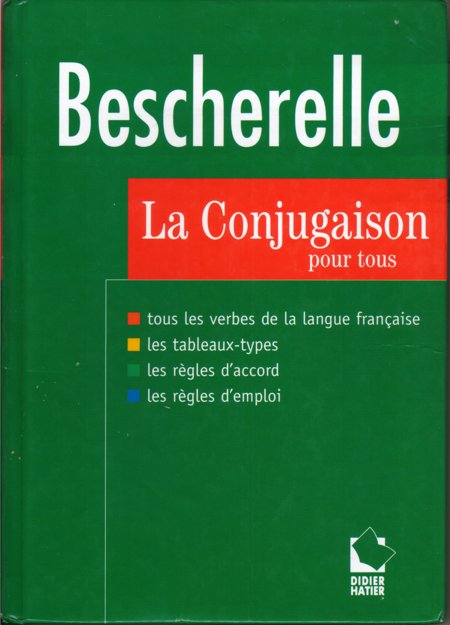
The book we had to learn by heart.
That program kept me busy, on and off, for 25 years. It started as an Excel macro, became a Visual Basic 6 application, a .NET client/server system for the classroom, a ClickOnce desktop app, a Windows 8 Store app, a game called Angry Verbs, a couple of web apps and, this year, a conjugation engine. Every rewrite was an excuse to try a technology I wanted to learn, so in hindsight it is a decent portfolio of how I learned to program.
I dug up the old backups, my mail archive from 1997 to 2007 and a handful of later repositories, and put every version I could find in one repository: woutervanranst/verbodrome6.
Before Verbodrome: Blue
I started programming in DOS batch files when I was seven. And by 1999 I needed a nickname for ICQ: BlueBoy (a reference to this song, and the programs I wrote with a few classmates needed a publisher. So we invented one: Blue®. The logo was a blue square with the name in white in the bottom-left corner. It was a play on the then just-launched third mobile operator in Belgium, Orange (after Proximus and Mobistar). It was an ad in the bus stop I took to school. I changed the color and the name and I thought that was very clever.

The original: Orange.
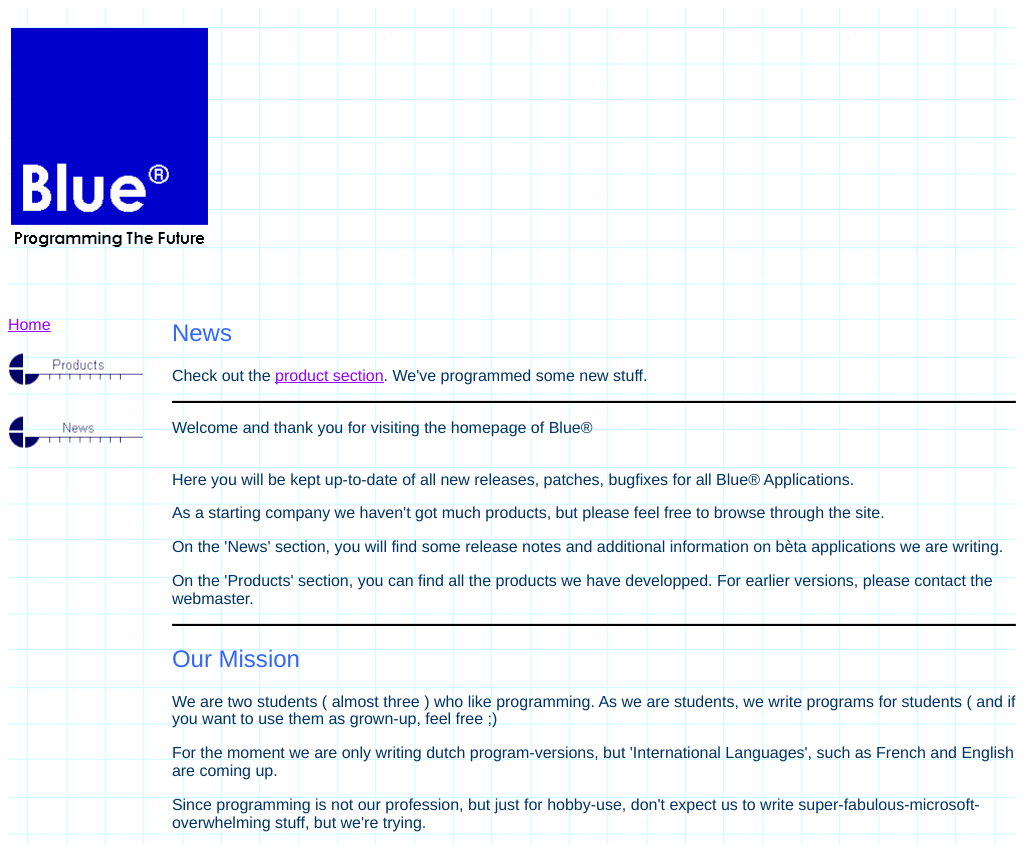
The Blue website, November 2000: “We are two students ( almost three ) who like programming. […] don’t expect us to write super-fabulous-microsoft-overwhelming stuff, but we’re trying.”
The product list had an encryption program called Deep Blue (named after IBM’s chess computer that had beaten Kasparov). Next to it were a periodic table quiz, a quiz on the capitals of Africa and English Irregular Verbs v1.4. That last one is the real ancestor of everything below: a list of verbs, a question, an answer, a log file.
Today Blue Software is the name of my company as a freelancer, a wink to the teenager who drew that square. When I incorporated in 2021, the logo was the blue square with the name in the bottom-left corner again. In 2025 it got a refresh.
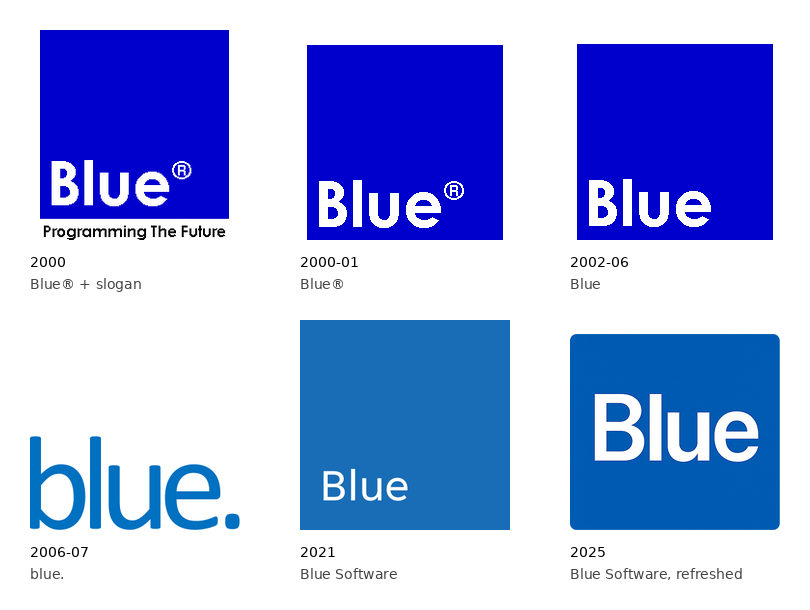
The Blue logo, 2000 to 2025.
2001: an Excel macro
The Bescherelle has 88 tables. About 150 of us in the fourth year had to learn them, and the first test was coming. Together with my friend Steven I put the verbs in an Excel sheet, one column per verb and one row per form, and wrote a macro that asked for a random form in an InputBox and said right or wrong in a MsgBox. The sheet was the database. Version 1 had 27 of the 56 verbs we needed; the manual asked for volunteers to type in the rest.
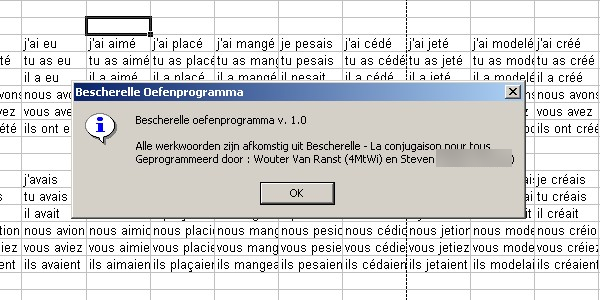
Bescherelle v1, September 2001. The worksheet behind the dialog is the database.
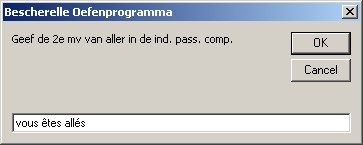
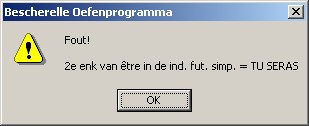
A question and a wrong answer. The log file shows the first session on 22 September 2001.
Only one thing was computed rather than typed. If a cell said just “avoir” or “être”, the macro built the compound tense from the auxiliary and the past participle. Keep that in mind: it took 25 years to get to the next step. The code is in 01-bescherelle-excel/v1.1, with the VBA extracted as text.
A presentation text I wrote two years later claims “the results of the tests went up considerably”. I have no data to back that up.
2002: diskettes, VB6 and a registration server
Version 2 (January 2002) got a settings window to pick the tenses and persons, points saved in the registry, a /cheat command (“Cheating NOT enabled… Crack the code, LÖSER”) and a release on diskette, with a label.
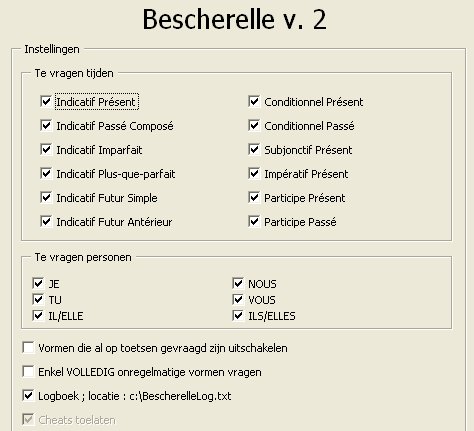
Bescherelle v2, January 2002.
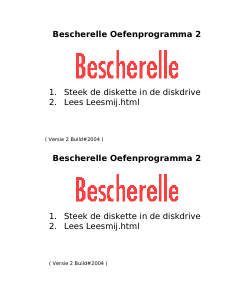
The diskette label, with Bescherelle in red like on the book cover.
The web page for v2 ends with “Het is vrijdagnacht, halftwee, het is koud en het regent. Ik stop ermee.” (It’s Friday night, half past one, it’s cold and it’s raining. I’m quitting.) Three more versions followed within six weeks: version 3 with a verb picker and questions in French or Dutch, version 3.5 with something I called the Blue Moon Engine, which pre-computed the list of forms it was allowed to ask, and version 4 with the subjonctif passé.
In March 2002 version 5 was the first one in Visual Basic 6. It still asked its questions in an InputBox, but now came with an MSI installer, a text database and 127 verbs. The 72 extra verbs came from Le Conjugateur, a program by Brewalan Le Drû. I wrote an Extra Verbes Extractor that parsed its text exports into my format. Version 5 also contained a time bomb (“Deze versie van het programma is verlopen” after August 2002) and a routine called BentUEenComputerAnalfabeet that asked “Are you computer illiterate?” and then tested whether you knew the /quit command.
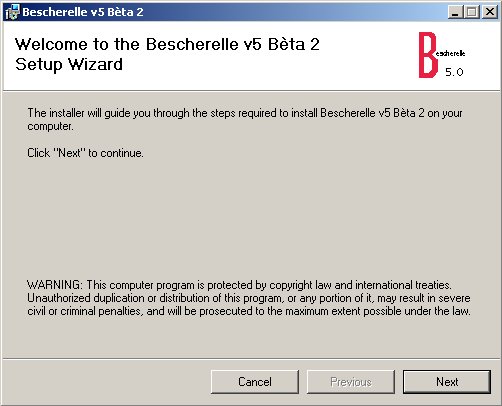
Bescherelle v5, March 2002: a real installer.
Version 6.0 (summer 2002) finally had a main window. Version 6.2 stored its 200 verbs in an Access database and had an interface in Dutch, French and English. I also wrote a custom OCX with Winsock client and server controls so the program could register itself online against a server on my home PC, behind a dynamic DNS name. On 23 August 2002 two of my teachers, my French teacher Eric Van Hool among them, got a beta CD with a letter. A few months later the to-do list says internetbrol wegwerken (get rid of the internet junk), and version 6.3 shipped without online registration.
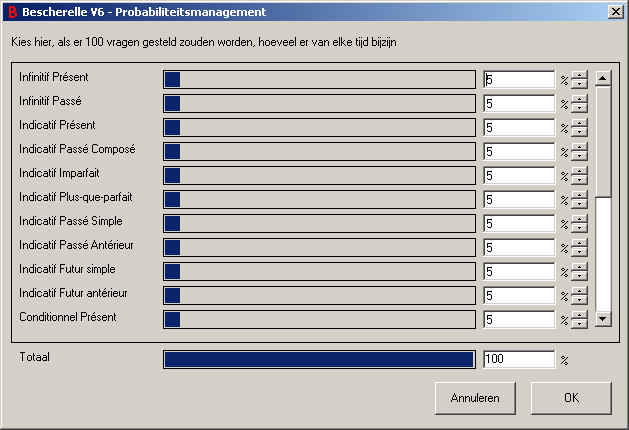
Bescherelle v6.2, “probability management”: you set how often each tense is asked.
The probability screen became a theme. In version 6.3 it turned into dynamic probability: the tenses you get wrong are asked more often. In December 2003 my maths teacher, Pascale, designed a better algorithm for it, and in some form that idea (every tense starts at the same weight, which halves on a right answer and doubles on a wrong one) is in every version after it.
January 2003: Bescherelle becomes Verbodrome
In January 2003 Eric Van Hool, by then my former French teacher, was so taken with the program that he wanted it registered. That raised an awkward point: Bescherelle is a trademark of the publisher Hatier. I needed a name of my own, and my friend Christian Wildiers came up with it: Verbodrome. In April I deposited it with SABAM, to ensure the ownership was formally cemented with me.
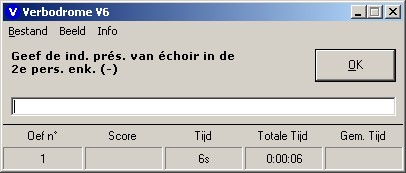
Verbodrome 6, February 2003.
On 9 February I mailed my whole class: “GERAAK JE OOK HELEMAAL IN DE KNOOP VAN DIE FRANSE WERKWOORDEN? […] *trompetgeschal* VERBODROME” (are you also completely tangled up in those French verbs? fanfare), with “( ja dit programma is volledig van mijn hand )”, yes, I wrote this program entirely myself. It was a 15 MB download. Danny got a CD and a printed manual as a New Year’s present. He called it “a professional approach”, but the CD was stuck in its sleeve with glue and could not be used.
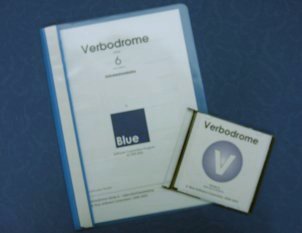
The deluxe edition: a binder with a printed manual and a CD. That’s how it was done back then.
During 2003 the VB6 code grew from about 4,400 to almost 9,000 lines. There was a score report with a mark out of 20 and an autorun CD. With version 6.31 teachers could create exercise series and verb lists and hand them out to their pupils as files, and 6.4 added a 30-day trial. Version 6.5 (October 2003) was a rewrite around classes, with licence keys. The build before it, 6.5 beta, sat in a folder called Laatste Niet-OOP, the last non-object-oriented one; put the two side by side to see the rewrite. Version 6.51 added local user profiles, and the last VB6 release was 6.6, in January 2004. All of them are in 02-vb6.
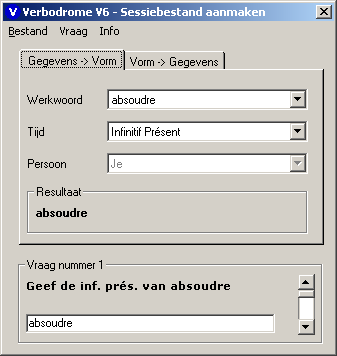
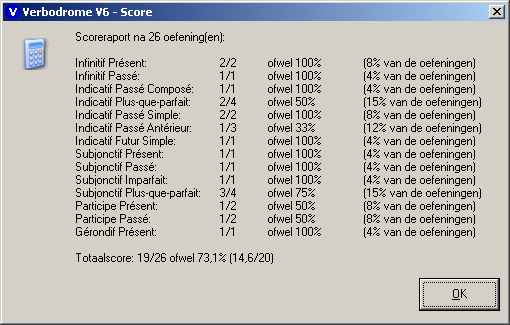
The session creator for teachers and the score report, Verbodrome 6.31 (April 2003).
Selling it: publishers and magazines
A standard licence cost €9.99, a deluxe edition with the binder €24.99. I asked in an email whether that income was “100% black money”. It was not legal, Eric answered, and he suggested invoicing it through VANAS “for a small percentage”. It never came to that, because there was very little to invoice.
The real plan was a publisher, and Eric Van Hool was the driving force behind it. He used Verbodrome in his classes, with verb lists per month that I shipped as database updates. He proofread my letter to the publishers, got me in at De Boeck through someone he knew there, and let me use his name as a reference, which opened more doors than mine did. The quote on the CD insert is his: “Saaie Franse werkwoorden vervoegen werd plots een uitdaging, een spel […] Het spel werd een competitie waarin iedereen de winnaar wilde zijn en ook werd.” (Boring French conjugations suddenly became a challenge, a game. The game became a competition that everyone wanted to win, and did.)
At the end of April 2003 I sent the letter and a trial version to the Belgian educational publishers. Van In first answered “we would like to look at the software” and in September said no: “Ik geef toe dat de werkwoorden een pijnpunt blijven” (I admit verbs remain a sore point), but a verb drill on its own did not fit their courses. De Boeck gave me a 45-minute slot on 8 October 2003 and cancelled it the day before. I did not take that well.
In October 2003 two magazines wrote about it. Netwerk, the magazine I read in 1999, printed a short piece without telling me. Clickx put the website in its top 5 under the title “Blauwe Wouter”.
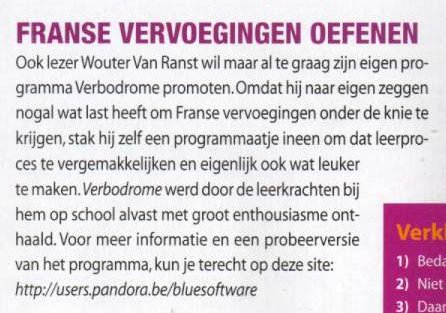
Netwerk, October 2003, page 118: “Verbodrome was received with great enthusiasm by the teachers at his school.”
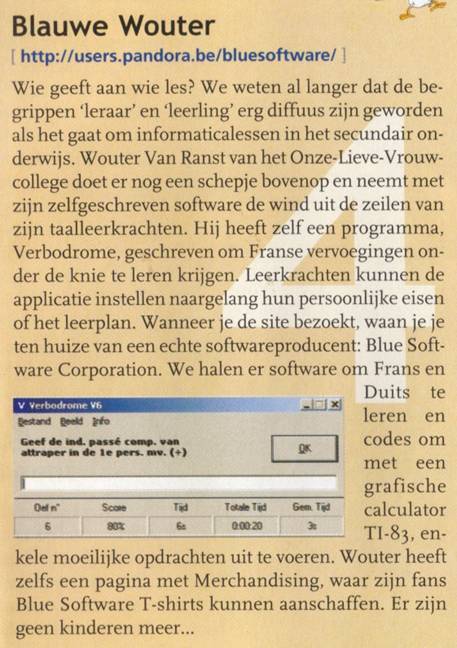
Clickx 51, October 2003. The last line reads: “Er zijn geen kinderen meer…” (Kids these days…)
The articles brought a few buyers, all parents. The first person to actually pay was An, a French teacher at Xaveriuscollege who had been testing it. Sophie Ann, the head of French at a school in Ghent, asked for a price for her computer lab after reading Netwerk. I forwarded her mail to Steven with one line: “JACKPOT ;)”. I don’t know if she bought it.
Then I wrote to the others: Die Keure, Standaard Uitgeverij, Wolters Plantyn, the e-learning company eXplio and, later, Visiria in the Netherlands. In January 2004 I mailed: “Onverhoopt heb ik afspraken met 4 uitgeverijen […] Misschien laat ik mij wel afschepen met 500€ (voor tweeëneenhalf jaar werk)” (Against all odds I have meetings with 4 publishers. Maybe I’ll let them fob me off with €500, for two and a half years of work). I was in my final year of secondary school and could only go on Wednesday afternoons. That winter I presented at De Boeck, Pelckmans, Die Keure and Wolters Plantyn.
All of them said no:
- Die Keure: “We vinden het op zich een zeer goed programma, maar zien er eerlijk gezegd niet direct een voldoende rendement in.” (We think it’s a very good program, but honestly don’t see enough return in it.)
- Wolters Plantyn: not selected for commercialisation. “Jammer, maar helaas!”
- Visiria asked the best question: “voelt u zich programmeur of bent u auteur Frans?” (Do you see yourself as a programmer or as an author of French?) Teaching verbs in context was work for an author, they wrote, not for a programmer.
- De Boeck thought it was “cool”, and would get back to me “within the year”.
- Pelckmans would “look into it further”. I’m still waiting.
Looking back, Van In and Visiria were right. A drill for verbs alone is a feature, not a product, and the people who decide what schools buy are not the pupils who use it. One of the parents who bought it, put it better than I could: “De uitgevers zijn natuurlijk niet de gebruikers.” (The publishers are, of course, not the users.)
Blue Software Corporation
By then I had renamed Blue to Blue Software Corporation, with a website at users.pandora.be/bluesoftware (/blue was taken by somebody who put up pictures of Braveheart), the slogan “Software is Architecture”, a news page, a support centre and a merchandising page.
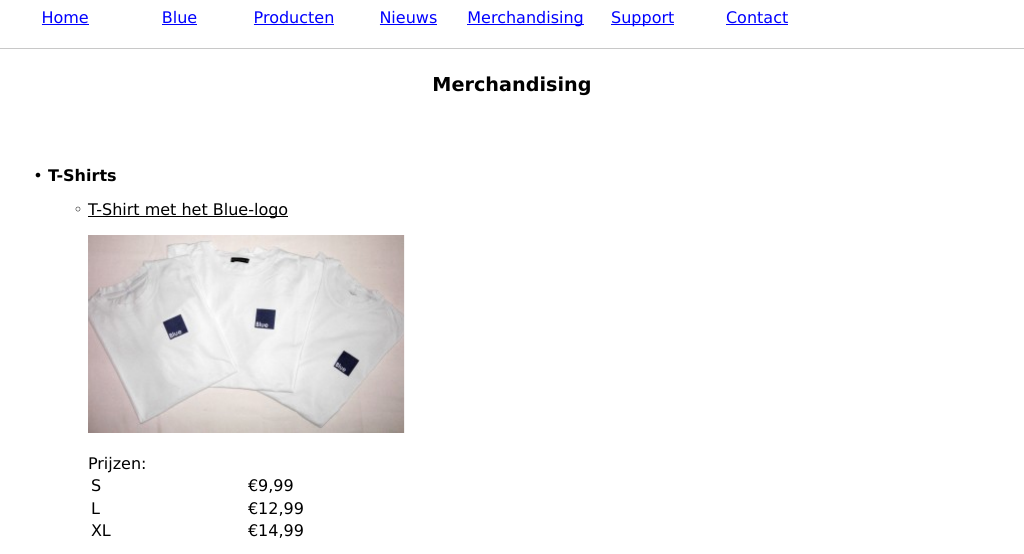
Blue Software T-shirts, 2003. Clickx noticed them too.
There were T-shirts with the blue square on the chest, in three sizes. Larger sizes were more expensive, because they had more fabric - obviously. Under “About Blue” a draft page said: “Onze software is onmenselijk: hij moet niet gereboot worden elke 24 uur.” (Our software is inhuman: it doesn’t need a reboot every 24 hours.)
The engine I couldn’t have
Every version so far stored the conjugations. I typed them in, extracted them or, later, scraped them. What I really wanted was an engine: give it any verb and it conjugates it, invented verbs included, because it knows the rules. Brewalan Le Drû’s site (today Le Conjugueur) could do exactly that, so I knew it was possible.
In August 2003 I mailed him to ask for his program. He had taken it off his site because he was rewriting it and concentrating on the website: “Après tout, il fait la même chose que le logiciel” (after all, it does the same thing as the software). The engine stayed his.
In June 2004 I tried to license an engine for a multilingual version. I offered Verbix “some royalty contract”. The makers of WinDi answered: “You will never reach the level of WinDi, 95 people have worked on this project! Why not develop something else?” I replied: “No offense, but I think you have very little to say about what I am going to develop.” I had not even finished secondary school.
2004: the classroom server
The idea for a network version came from An: a teacher should be able to follow the whole class from one screen. In October 2003 I wrote my first C# code: a console server on port 6000 with one thread per client and a line-based text protocol, a GUI version called VerboServe, and on the side Konjugator, a small trainer for German verbs. The Verbodrome 6.6 beta got a network client to talk to it. On 20 October I mailed An the first handshake, “het ontspruiten van uw gedachtegoed” (your idea, sprouting):
CS: AUTH_REQUEST Verbodrome Build 6500.20031007
CS: AUTH_USER Wouter
CS: AUTH_PASS hallo
CS: AUTH_PCID 481606069
CS: AUTH_KEY 2EF13A0B
SC[0]: AUTH_AUTHENCITATED USERNBR 1 BUILD BETA
“De eerste communicatie tussen Verbodrome-server en Verbodrome-client: de aanmeldprocedure!!!!!” (The first communication between Verbodrome server and client: the login procedure!) The spelling of AUTHENCITATED is original. Authentication is hard.
The server grew into Verboserve 6, with an Access database, and a later 6.6 build of the VB6 client got a login screen for it.
Danny had told me: “VB6 is over, .NET Framework and C# are the new kids on the block.” So naturally I wanted to try that, and in the summer of 2004, after my final exams, I rewrote everything in C# on .NET 1.1 (a prototype in August, version 7.0.1 in September): Verbodrome 7 for the pupils, Verboserve 7 for the teacher, and a shared library, Verbosystem, code name Bellerophone (a reference to Mission: Impossible 2). It used .NET Remoting over TCP. The pupil’s session lived on the server as a MarshalByRefObject, and the client was “only a thin shell” that showed what the server sent. The draft website said: “Twee jaar expertise. Een half jaar ontwerptafel. Een maand ontwikkeling. Verbodrome 7 is een feit.” (Two years of expertise. Half a year at the drawing board. One month of development.)
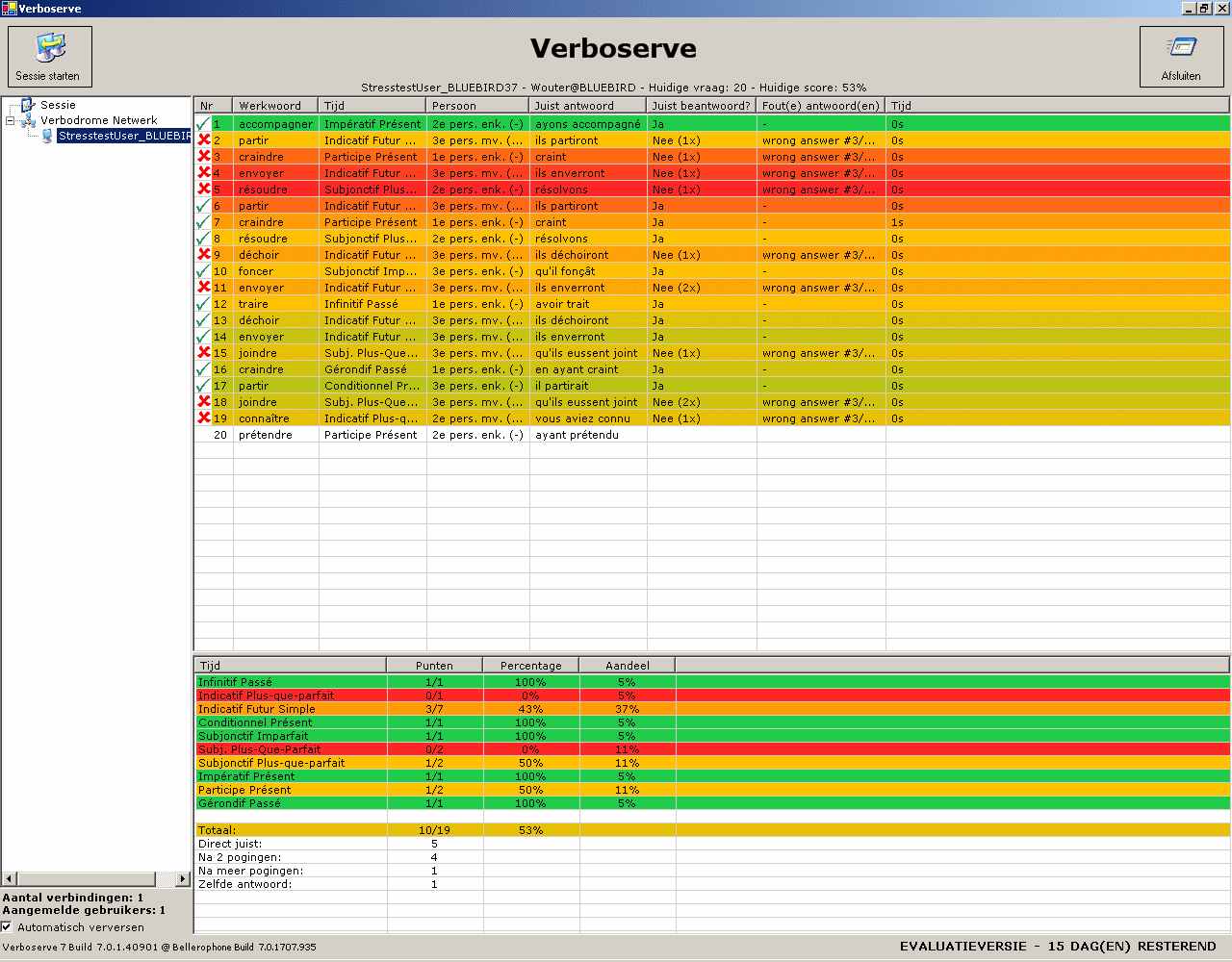
Verboserve 7, September 2004: the teacher’s live view of a session, here with a stress-test user.
The teacher started a session with a wizard: individual or shared questions, which verbs and tenses, a time limit, and a competition mode where every pupil saw their rank (“Je staat laatst…”, you’re last, followed by how many points the next one was ahead). The background of the client changed colour with your score, from green to red. I wrote to a parent in 2006 that the colour does hurt when you score below 20%, “but that’s a bit the point”.
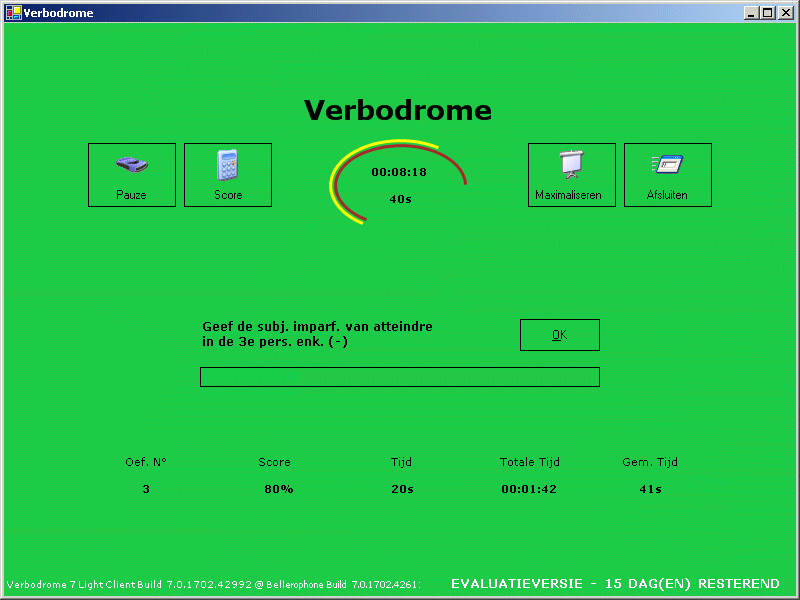
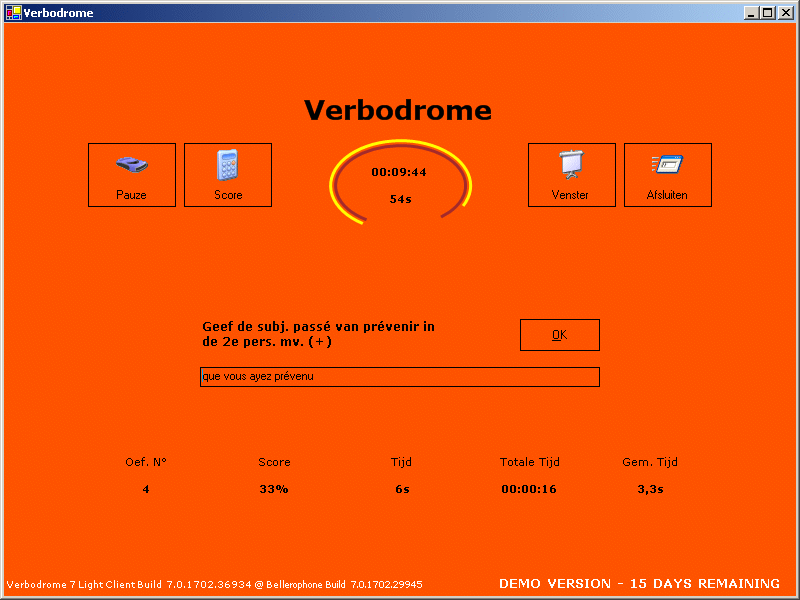
Verbodrome 7 at 80% and at 33%.
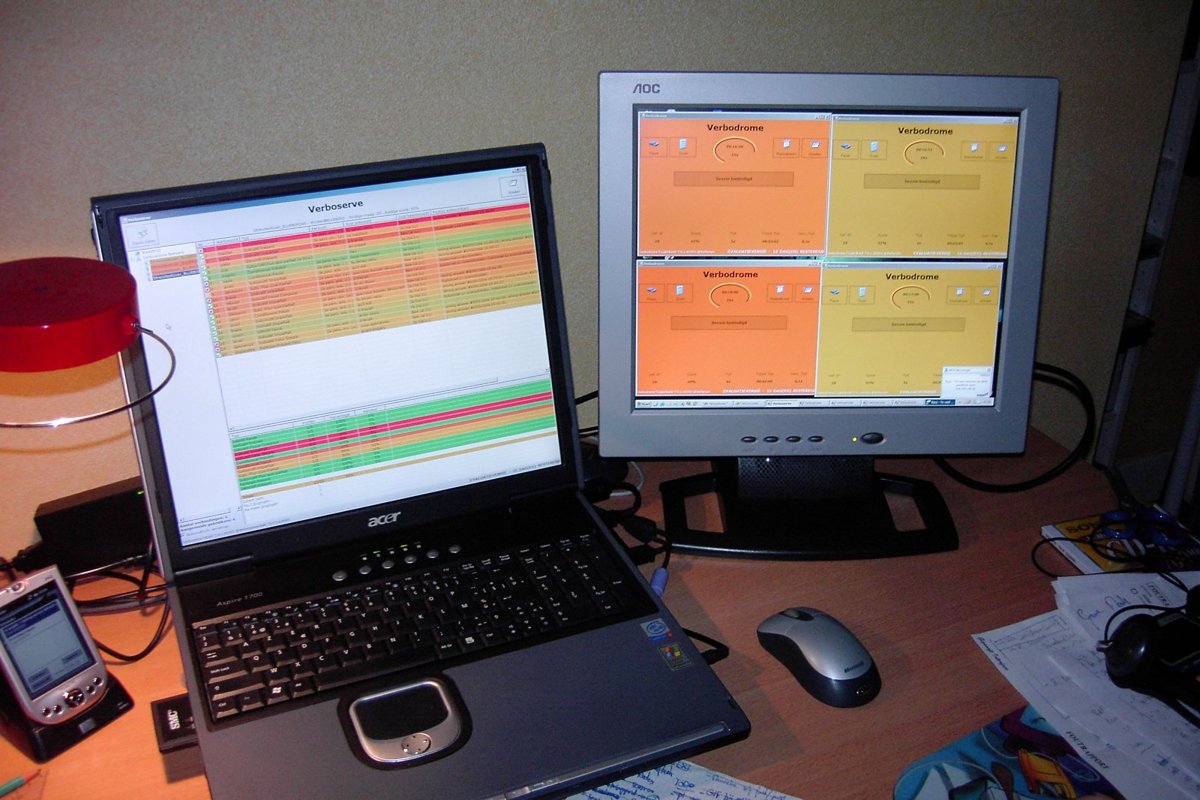
8 September 2004: Verboserve on the laptop, four stress-test clients on the monitor.
On 13 September 2004 I installed it at my old school, on Windows 98 machines with .NET 1.1: “VERBODROME WERKT!!! (op de krotcomputers van t OLVC :-))” (it works, on the school’s crappy computers). A week later, during the session where I explained it to the French teachers, it crashed: “4 weken (à 15 uur per dag) werk in minder dan een seconde in rook te zien opgaan doet pijn.” (Watching four weeks of work, at 15 hours a day, go up in smoke in less than a second hurts.) University started the same week.
In April 2005 I opened the code again: “Tot mijn groot spijt/verdriet/woede/onmacht/frustratie versta ik niets meer van mijn code.” (To my great regret/sorrow/anger/helplessness/frustration I no longer understand any of my code.) Danny answered: “Programmeren <=> Studeren … het 2de moet nu.” (Programming versus studying, the second one has to happen now.) A file called Final Notes.txt, dated 13 August 2005, ends it: “onopgeloste bug, te grootschalig, te weinig tijd” (unsolved bug, too large, too little time). The code is in 04-verbodrome7/v7-final.
2006: Verbodrome 8
In September 2006, at the start of my third year at KU Leuven, a parent who had bought a licence in 2004, asked for a new key. He thought I had stopped. I sent him the key generator, and two months later, “in een ambitieuze bui” (in an ambitious mood), I had a new version: Verbodrome 8, a standalone C# WinForms app on .NET 2.0 with SQL Server 2005 Express, installed with ClickOnce. Licences were XML files signed with an RSA (another obsession of mine) key: you mailed your licence request, I signed it and mailed it back. “Programmeren tot 5 uur smorgends is zalig.” (Programming until 5 in the morning is bliss.)
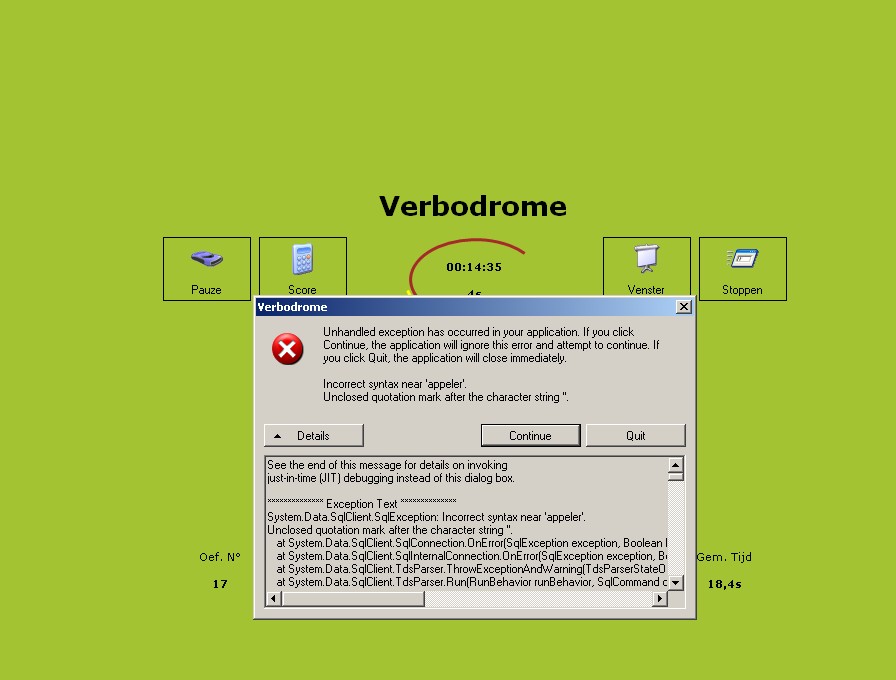
Verbodrome 8, 30 November 2006. The verb was s’appeler, and the apostrophe ended up in a SQL string. A textbook SQL injection, by a French verb.
I added German and, in December 2007, Spanish: I was on Erasmus in San Sebastián and needed to train Spanish verbs myself. Along the way I moved to Visual Studio 2008, inside a Windows VM on a Mac (I bought one because of the Vista debacle). A tester was honest: “eigenlijk komt het er op neer dat de vorige versie beter was” (it comes down to the previous version being better). The installation was too heavy, the colours too loud. And about the planned price of €5 a year: “zwier die 5 euro van de website” (throw that €5 off the website). The last build is from March 2008. There never was a final release.
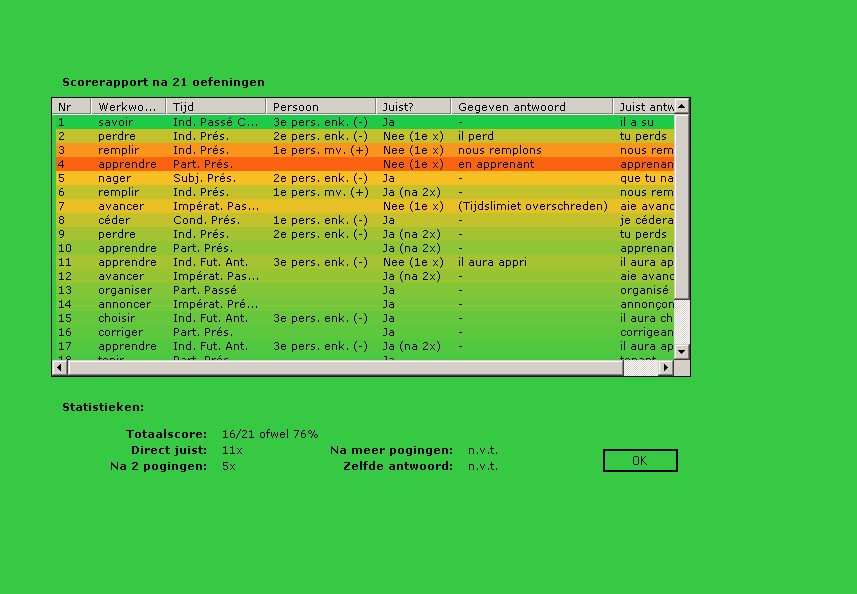
A Verbodrome 8 score report.
2012: Windows 8
From 2011 to 2014 I worked at Microsoft as a solution sales for Windows 8, so in the summer of 2012 Verbodrome became a Windows 8 Store app: Verbodrome 9, C# and XAML on WinRT, with a home-made MVVM layer and the score colour still in the background.
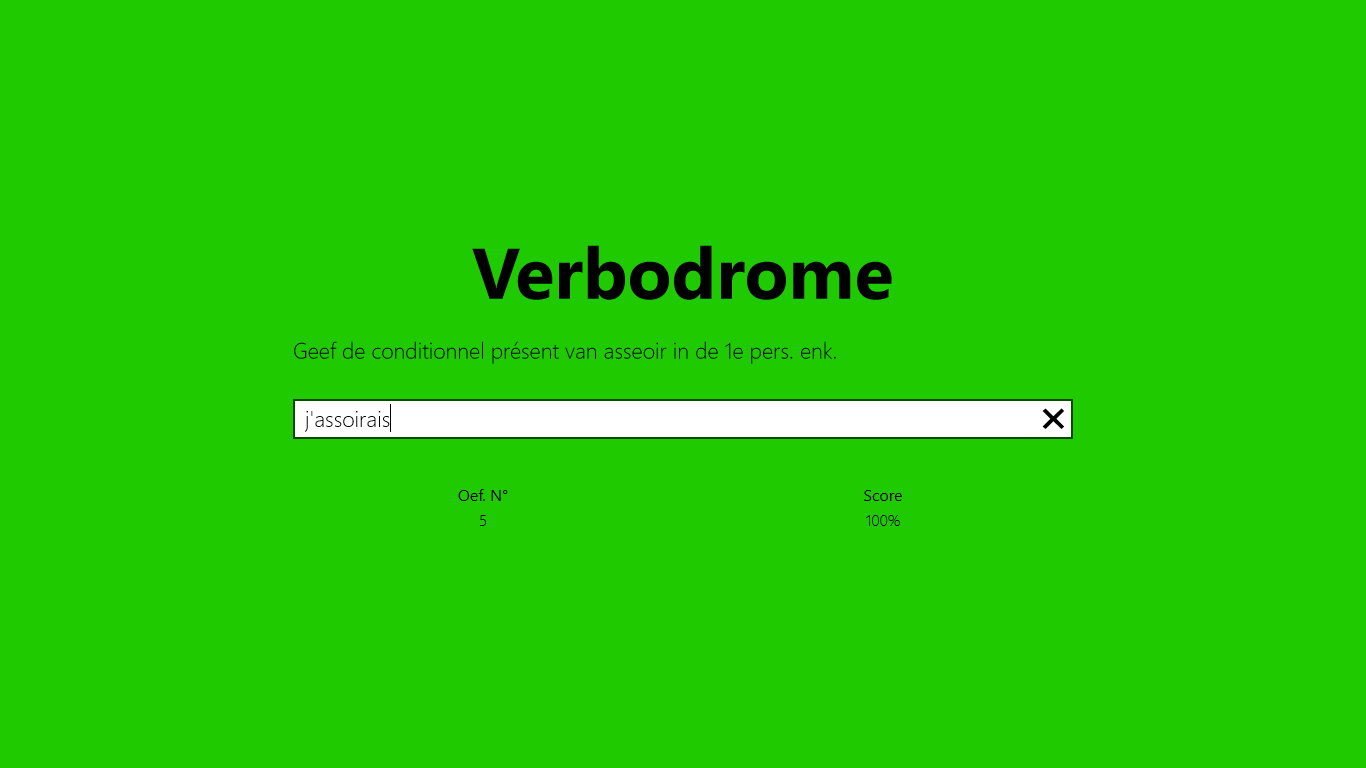
Verbodrome 9, September 2012.
It supported five languages: French, German, Spanish, English and Latin. The verbs came from a Parser console app that downloaded conjugation pages from five websites and turned them into XML. Still a list, just a longer one.
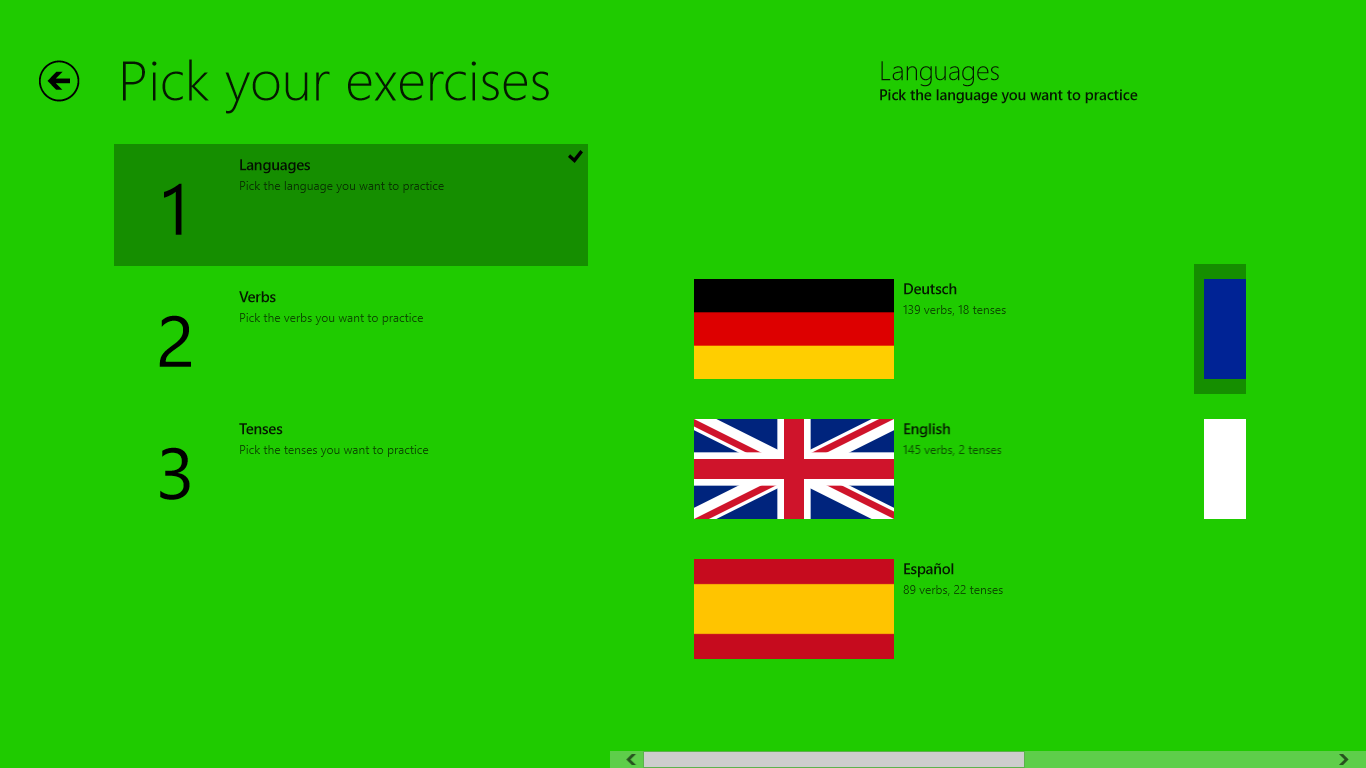
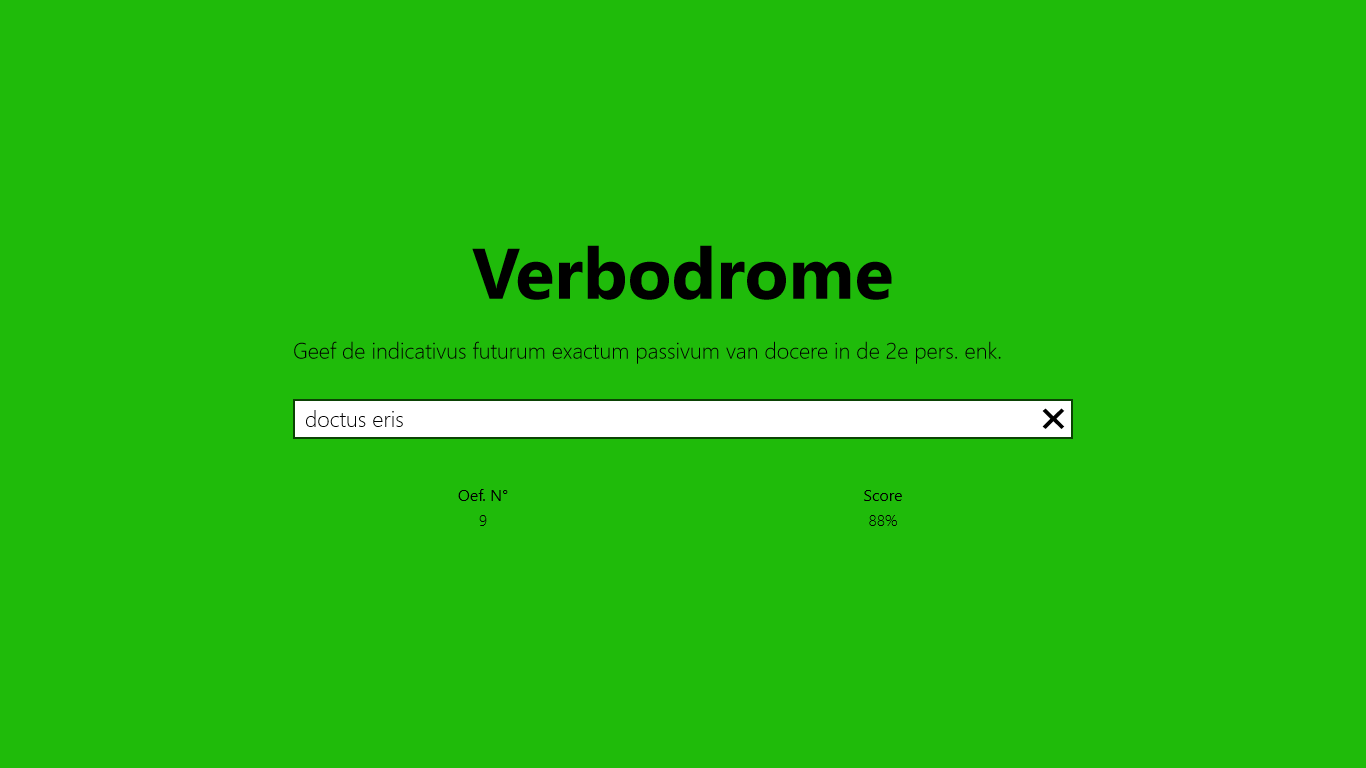
Picking exercises, and a Latin question.
The feedback page grew from one case to five: first time right, first time wrong, right after a mistake, wrong again with a new answer, wrong again with the same answer. And for the first time the app looked up what you had typed and told you which form it was.
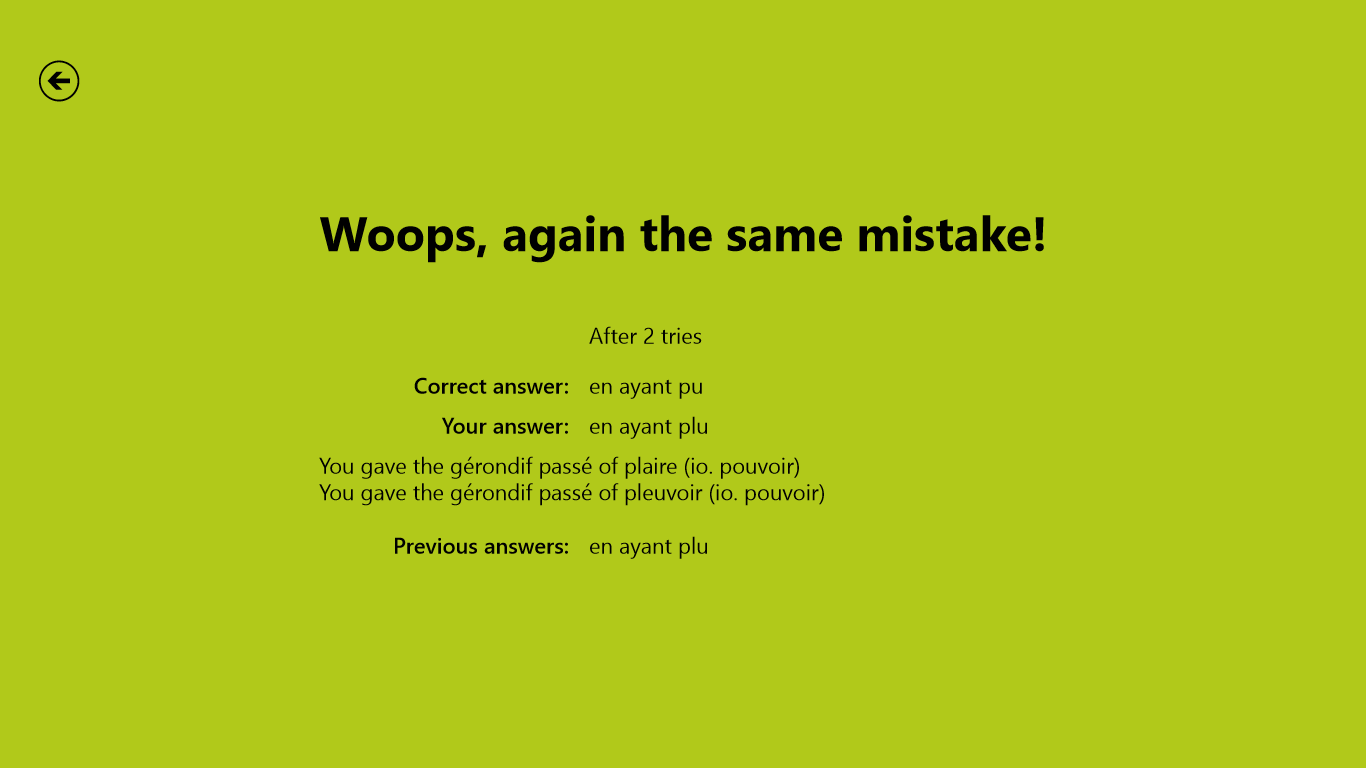
“You gave the gérondif passé of plaire (instead of pouvoir).”
From version 9.2 on, the app cost €2.60 or $3.49 with a free trial. The first sale came on 22 October 2012, four days before Windows 8 went on sale in the shops. The sales export of May 2013 has 25 transactions, one of them a refund.
I proudly showed the Store app to Mitch Cap, a colleague at Microsoft. His first question: “But does it run on Azure yet?” It didn’t. A few weeks later Verboserve was back, this time as WCF services on Azure Cloud Services (an ExtraSmall web role, two instances). It served teacher profiles: type a code in the app and you get your teacher’s selection of verbs and tenses. That was the last Windows 8 version. The source went into the Team Foundation Service preview.
2013-2015: Angry Verbs, and a photo of Berlin
Version 10 got a new name, inspired by Angry Birds: Angry Verbs, with a >_< face as logo.

The inspiration: Angry Birds.
There was an Arcade mode, a Campaign with levels, stars and padlocks per mood, and a Teacher mode. Only one page of its code survived: the campaign page. Later it also became a website on Azure, which is how I learned AngularJS. Every language got a background photo: the Eiffel Tower, Big Ben, Amsterdam canals, the Roman Forum, Berlin.

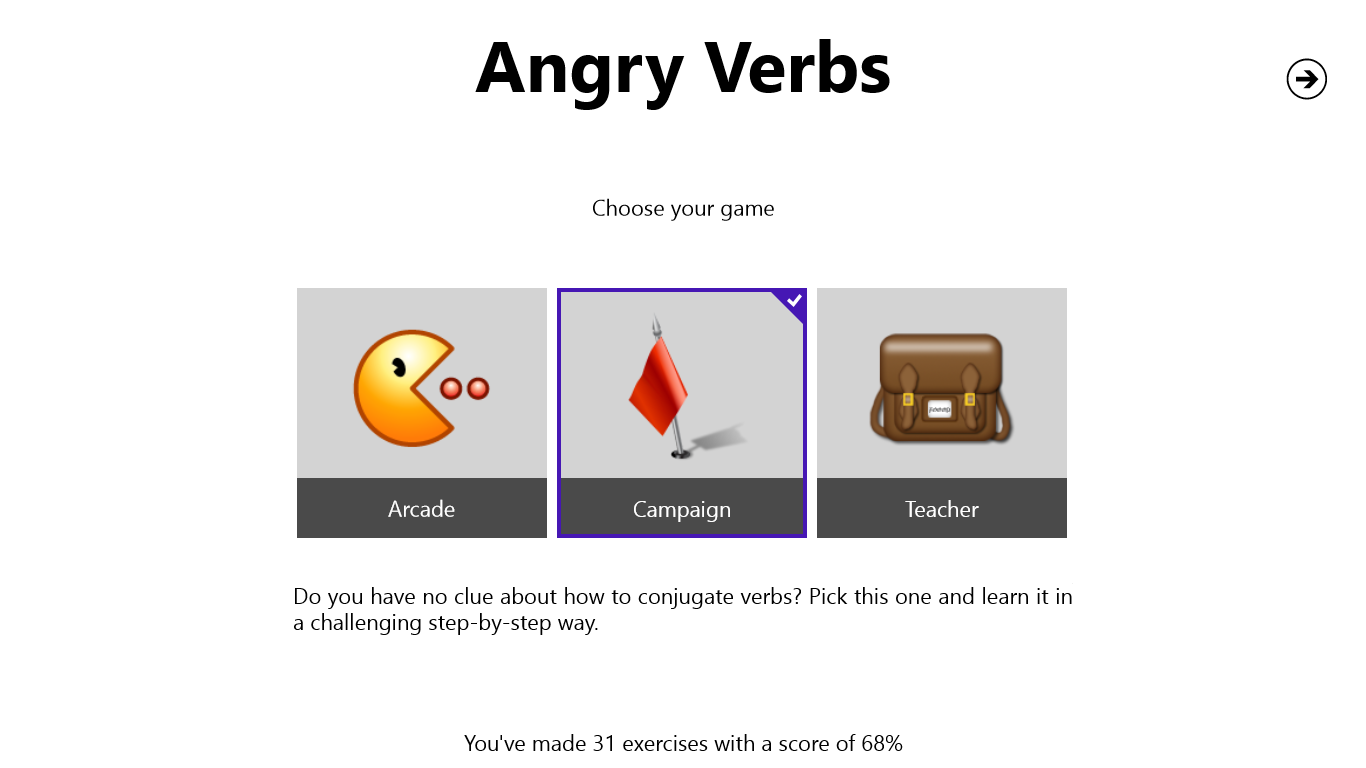
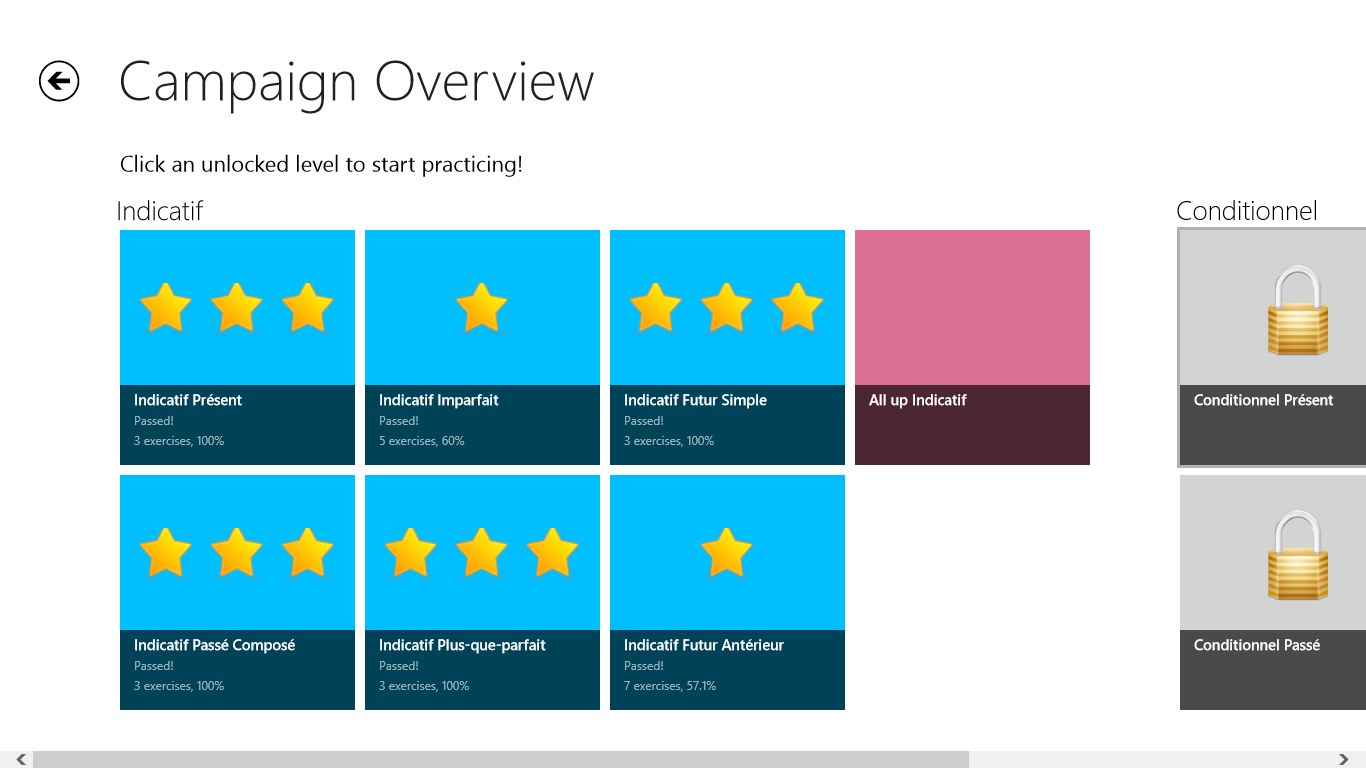
Angry Verbs: the logo (2014), the game modes and the campaign.
The photo for German was a Berlin skyline at dusk. I found it by googling “Berlin”, and just took a picture. But in 2015 I received a letter came from a German lawyer (dare I say extortionist) threatening to sue me for €1,253. I took the site down and, after a lot of stress and my first contact with a real lawyer, settled for €200.
Looking back, it is a bit ridiculous: €200 for a photo, and the end of a project I had carried since secondary school. I didn’t put Angry Verbs back online.
2020: VerbodromeX
During the 2020 lockdowns pupils were practising at home, and I picked it up once more. For some time, I had wanted to give .NET Core a spin, but the pre-3.0 versions were lacking in authentication. VerbodromeX ran on verbodrome.eu: ASP.NET Core 3.1 Razor Pages, Entity Framework Core, an Azure App Service with swap slots, Azure AD B2C, Application Insights, and a Let’s Encrypt certificate I had to renew by hand. The parsers now scraped seven languages.
Two things were new. Questions became multiple choice, asked from a Dutch prompt. And the score page analysed your mistakes: Deze tijden verwar je regelmatig, these tenses you mix up regularly. That was an idea from a mind map I drew in February 2003 and never built.
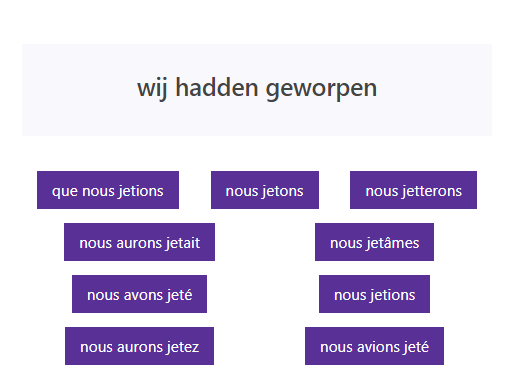
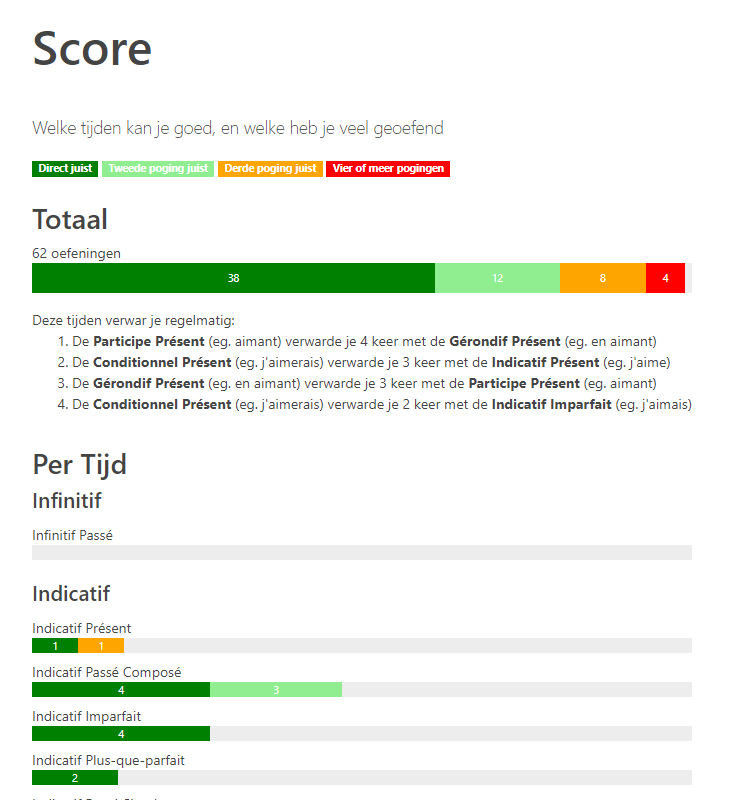
VerbodromeX, October 2020.
I mailed it to a few language teachers (“Met Verbodrome geen getreur”). The last code commits are from October 2020. Deeply convinced that nobody wants to spend money on training verbs, I came up with a new pet project, Arius.
2026: an engine, finally
All this time the conjugations were data. Typed by hand in 2001, extracted from websites thereafter. In 2012 I started a FrenchConjugator.cs with real rules, but never got it to work. In June 2025, trying out Codex, I let it port Verbodrome 6 to a .NET console app; its conjugator only knew the regular verbs. It was an itch that needed scratching for 25 years.
So I gave Fable 5.1 this crappy prompt:
in typescript, make a verb conjugation engine. it should start from the grammatical rules,
it can hardcode the exceptions but it should not just ’store all conjugations’ -
it should also work with invented verbs and correctly apply the rules

It should support multiple languages, lets start with French (‘fr’) and Dutch (‘nl)

For French: use https://leconjugueur.lefigaro.fr/regle as grammar
Use the corpus available at https://github.com/woutervanranst/VerbodromeX/tree/master/code/VerbodromeX.Database.Parsers/SourceFiles/Fran%C3%A7ais to build your test suite

For nederelands, find an authoritative source
Use the corpus available at https://github.com/woutervanranst/VerbodromeX/tree/master/code/VerbodromeX.Database.Parsers/SourceFiles/Nederlands

The future use is for a web app, but for now make it a simple cli wrapper around the main entrypoint function along the lines of conjugate(language (‘fr’/‘nl’, infinitive, mood, tense, person (1/2/3), number (singular/plural))

For French, use the mood/tense namings from the bescherelle

Refer https://en.wikipedia.org/wiki/French_conjugation
https://nl.wikipedia.org/wiki/Werkwoordsvervoegingen_in_het_Nederlands
An hour later I had a rule-based engine for French and Dutch. The scraped corpus from VerbodromeX, the thing I had always used instead of an engine, became its test suite. It conjugates verbs that don’t exist:
npm run cli -- fr ploucer --mood indicative --tense present --person 1 --number plural
# nous plouçons

npm run cli -- nl zorpen --mood indicative --tense past --person 1 --number singular
# ik zorpte
I then prompted for a Verbodrome reincarnation as a mockup in Claude Design and let Fable implement it:
Consider this Claude Design project. Implement it.

the goal is that the conjugation engine (which now makes up the repository) is a
standalone module that is referenced / used by other apps. you may modify it to enable the
aforementioned application if needed (eg. to generate purposefully wrong answers) but if
you can isolate them in the 'core' verbodrome functionality that would be better. would it
be possible to host this as a static website?
There it was. Better than what I was able to build over the last 25 years, in under an hour.
You can try it at wouteronarchitecture.com/verbodrome. The #1 feature that people kept asking but I never got around to for is also there (after one additional prompt): what kind of mistake you made: verkeerd hulpwerkwoord (wrong auxiliary), verkeerde stam (wrong stem), indicatief na que. Missed questions come back after four to eight others, and weak tenses are asked more often, the same idea as Pascale’s algorithm from 2003.
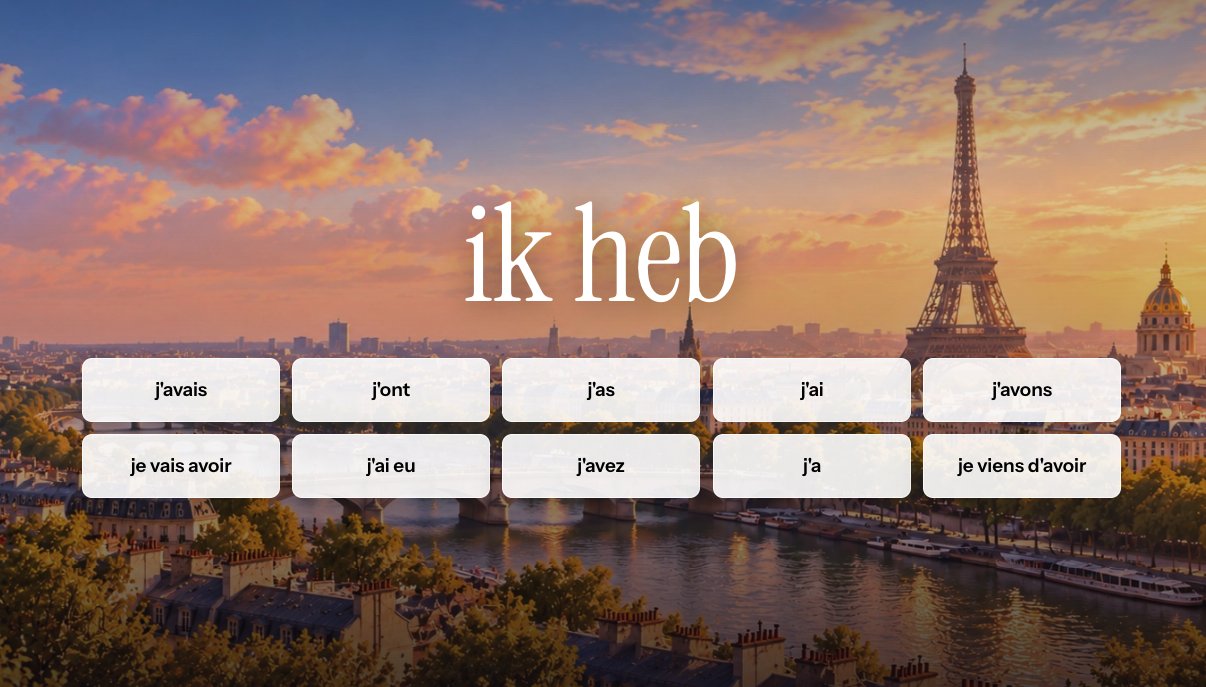
Verbodrome, 2026. The Paris in the background is AI-generated. I had learned my lesson about city photos.
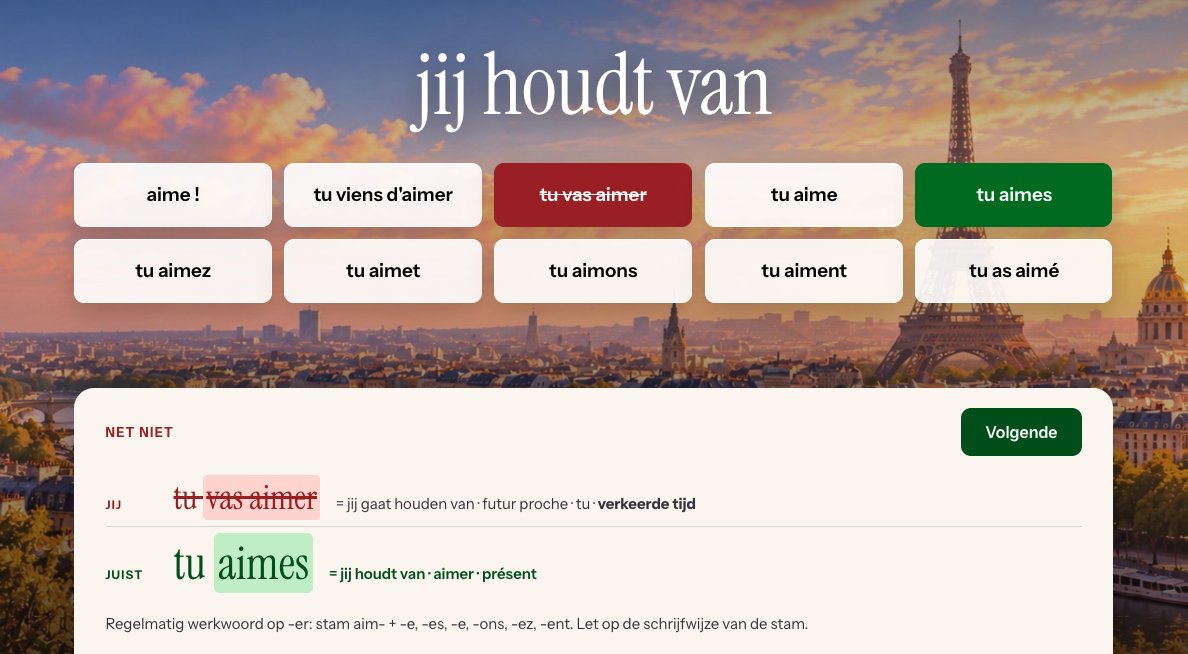
The feature everybody asked for: “tu vas aimer” means “jij gaat houden van”, futur proche, so verkeerde tijd (wrong tense), followed by the rule for regular -er verbs.
Looking back
Over 25 years I must have spent well over a thousand hours on this program. The thing I wanted most from the beginning, an engine that knows the rules, now came out of one prompt and an hour of work. I find that amazing, and it hurts a little.
Look at what is in that prompt, though. In the Arius 7 post I found that agents implement the domain concepts you give them and don’t invent the ones you leave out. This prompt contains the one domain decision I had been carrying around since 2001: start from the rules, don’t store the conjugations. The other requirements (invented verbs as the test, the Bescherelle names, the scraped corpus as test data) all come from earlier versions. Without those versions I would not have known what to ask for.
The other thing I see now is what the project actually was. It barely made any money, the publishers turned it down and a photo ended it. But every version taught me something I used later: VBA, VB6 and Access, sockets and .NET Remoting, WinForms and ClickOnce, WinRT, WCF on Azure, AngularJS, ASP.NET Core with Azure AD B2C, and now working with agents. It was where I tried out new technology, and French verbs were the test case every time.