Most of us default to advice-giving. Someone comes to us with a problem, and before they’ve even finished their sentence, we’re already formulating a solution. It feels helpful. It feels efficient. But Michael Bungay Stanier argues it’s actually one of the most counterproductive habits we carry into our work and relationships. His book The Coaching Habit: Say Less, Ask More & Change the Way You Lead Forever offers a deceptively simple framework for breaking free from what he calls our “advice monster” - and it all comes down to seven questions.
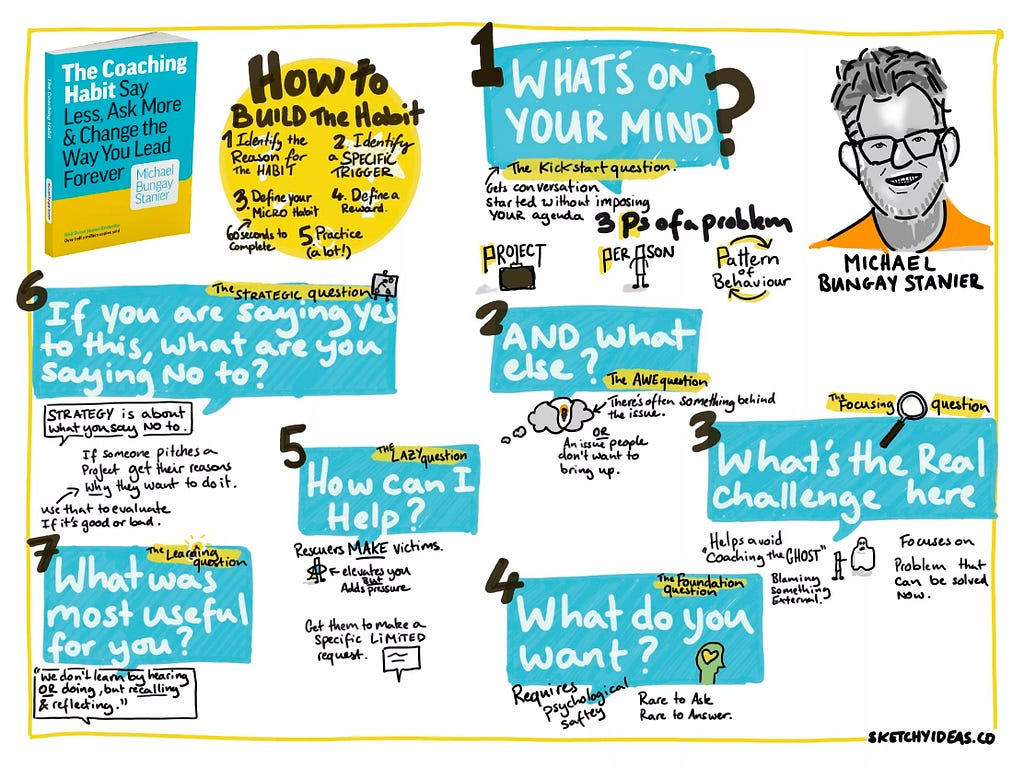
Source: https://sketchyideas.co/the-coaching-habit-sketchnote/
1. The Kickstart Question: “What’s on your mind?”
This is how you open almost any conversation. It’s broad enough to give the other person control, but focused enough to avoid aimless small talk. It invites people to go straight to what matters most to them. Stanier suggests pairing it with what he calls the “3P” framework - you can ask whether the challenge is about a project, a person, or a pattern of behavior. This helps focus the conversation without you having to guess what someone needs.
2. The AWE Question: “And what else?”
Possibly the most important question in the entire book. “And what else?” - or AWE - does three things. It stops you from latching onto the first thing someone says. It generates more options and ideas. And it buys you time before your advice monster takes over. Stanier recommends asking it at least three times in any coaching conversation. The first answer is rarely the best or most complete answer.
3. The Focus Question: “What’s the real challenge here for you?”
This is the question that cuts through the noise. Conversations often swirl around multiple issues, vague frustrations, and abstract complaints. “What’s the real challenge here for you?” forces specificity. The words “for you” are critical - they bring the focus back to the individual rather than letting them deflect onto circumstances or other people. This is often where the real coaching begins.
4. The Foundation Question: “What do you want?”
It sounds simple, but most people struggle to articulate what they actually want. We’re much better at describing what we don’t want, what’s frustrating us, or what other people should be doing differently. This question demands clarity. And when someone names what they want, it shifts the conversation from problem-dwelling to forward motion.
5. The Lazy Question: “How can I help?”
Stanier calls this the “lazy” question not because it’s low-effort, but because it saves you from doing unnecessary work. Instead of guessing what someone needs from you - and often guessing wrong - you simply ask. It’s also a subtle accountability move: it forces the other person to make a direct, specific request rather than leaving you to assume responsibility for their problem.
6. The Strategic Question: “If you’re saying yes to this, what are you saying no to?”
This is a question about tradeoffs, and it’s one that most teams desperately need. We live in a culture of perpetual overcommitment. Saying yes to something new without acknowledging what it displaces is a recipe for burnout and mediocre execution. This question brings the hidden cost of commitments into the open. It applies to projects, meetings, priorities, and even personal boundaries.
7. The Learning Question: “What was most useful for you?”
This closing question does double duty. For the other person, it creates a moment of reflection that helps solidify whatever insight emerged during the conversation. For you, it provides feedback on what actually landed. It also ends the conversation on a note of value, reinforcing the habit of having these kinds of exchanges in the first place.